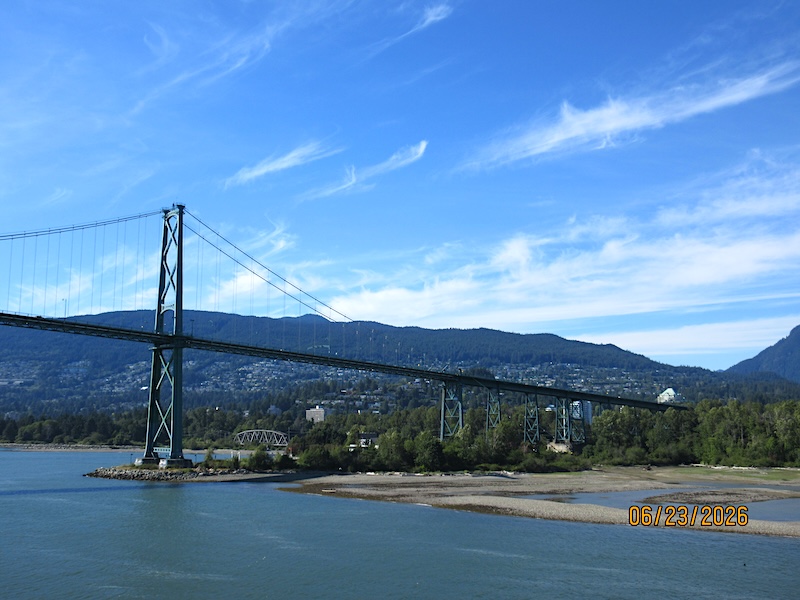
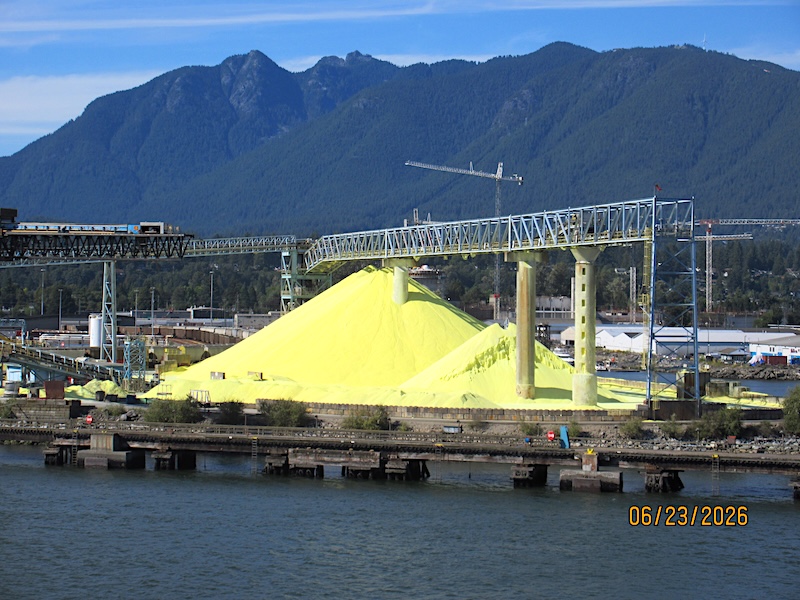
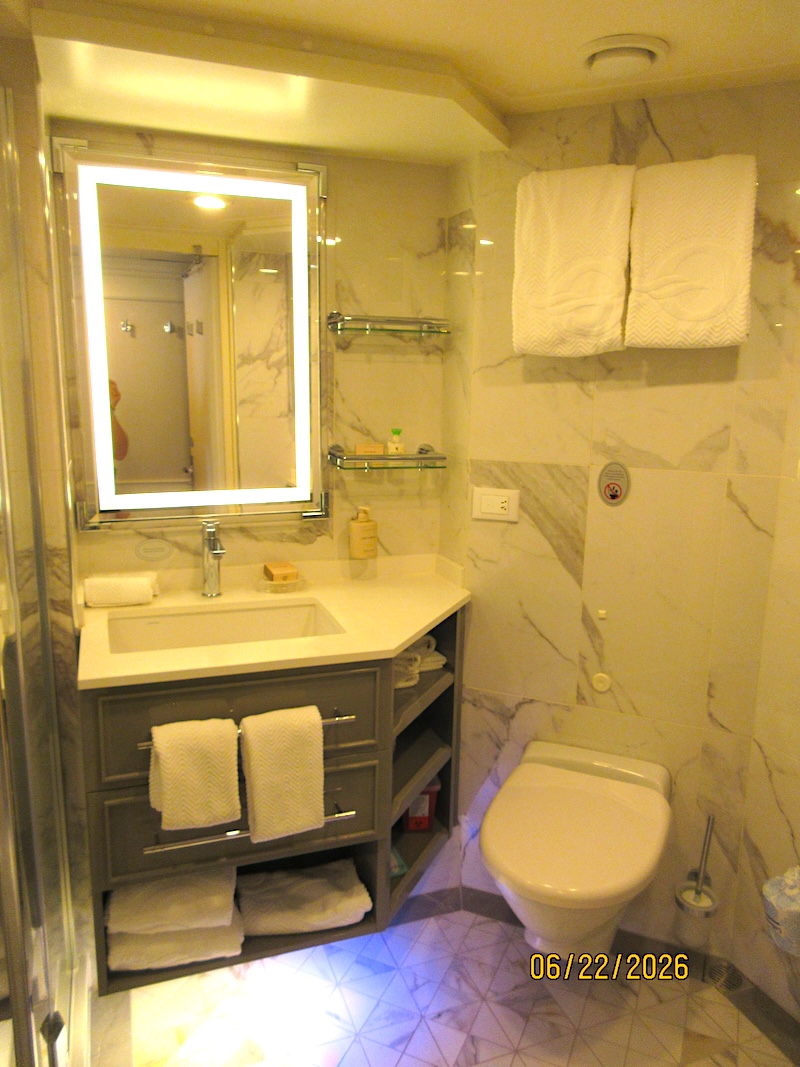
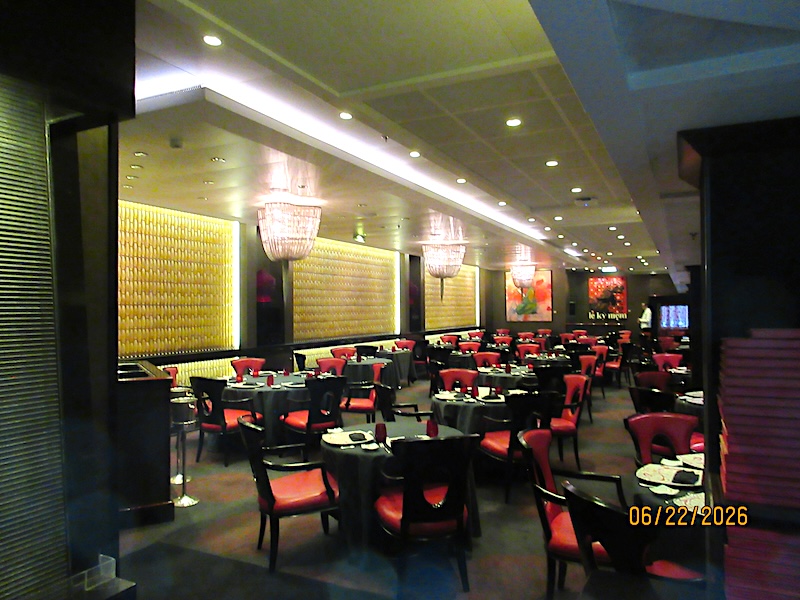
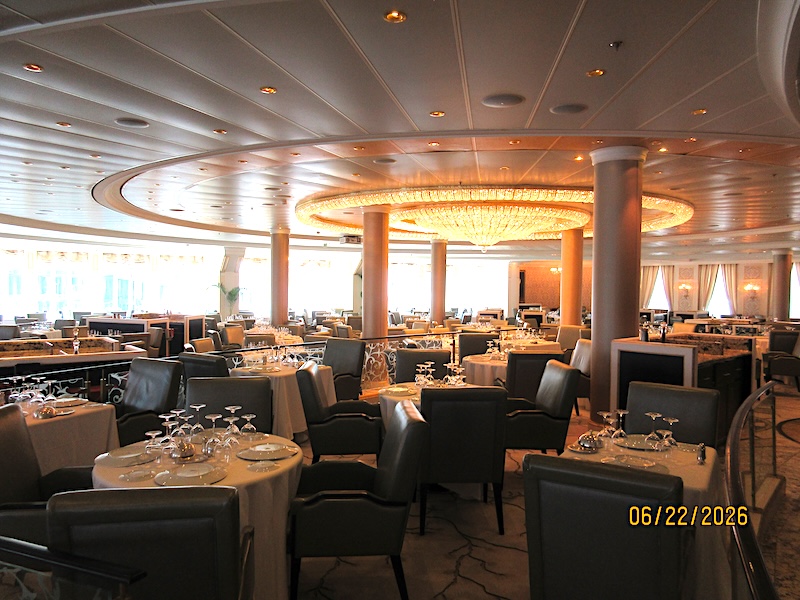
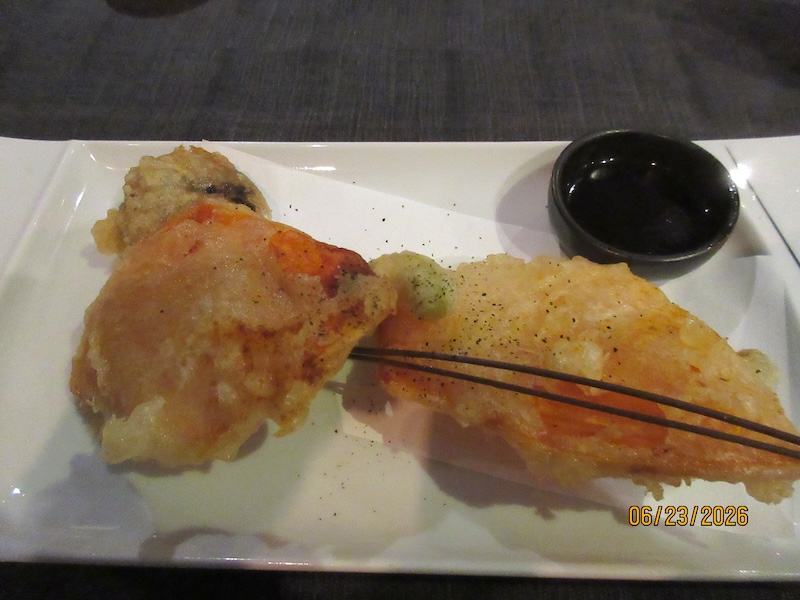
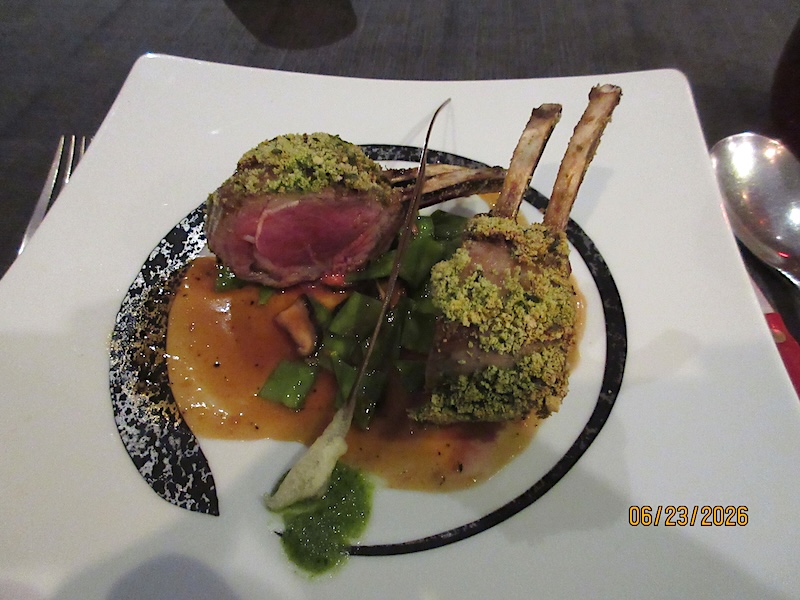
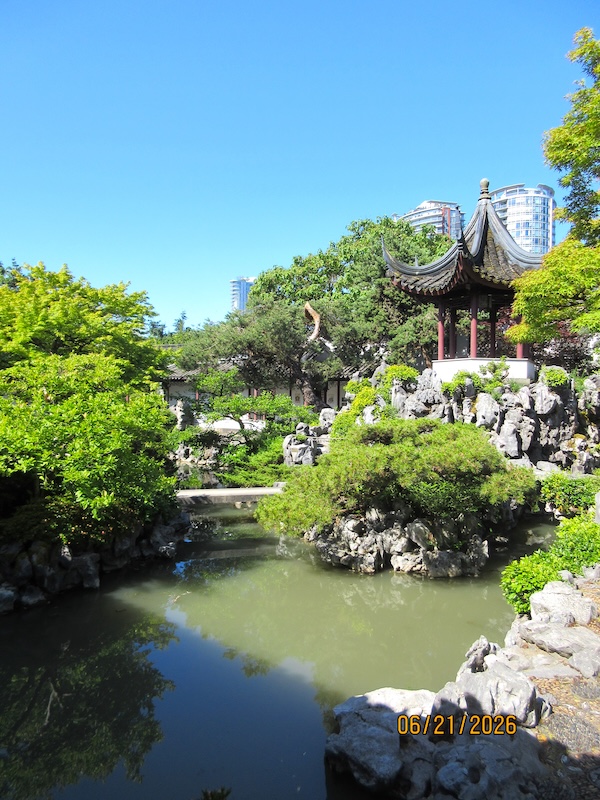
Vancouver BridgeSulphur Mound in North VancouverOur CabinCabin BathRed Ginger RestaurantMain Dining RoomTempura VegetablesLamb Chops
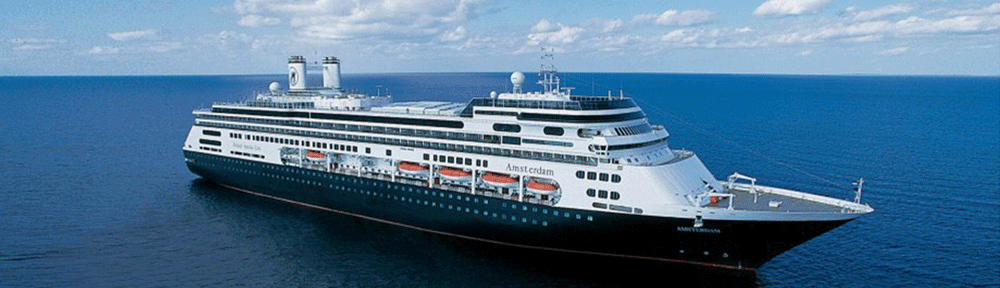
We enjoyed breakfast in our hotel again. Mark walked for about an hour into Stanley Park and along the sea wall. About 10:00am we checked out of our hotel and took a Lyft to our home for the next ten days, the Oceania Riviera cruise ship. The ride to the ship was only about 15 minutes and it took us about 45 minutes to get through security, customs and checked in. Once onboard we enjoyed a wonderful buffet lunch in the Terrace Café. There were way too many things to choose from like a large salad bar, a pumpkin and carrot soup, burgers, roasted turkey, pasta, roasted pork, sandwiches, pizza, roast beef and more.
The 15-deck vessel accommodates 1,250 passengers when full and is an adult only cruise ship. They have 800 crew members from 52 nationalities to serve the guests. The ship blends elegance with contemporary design, including a Lalique Grand Staircase. The ship includes four specialty dining venues in addition to its main dining rooms, all day buffet, poolside grill and pizzeria. There is the Red Ginger Asian, Jacques French, the Polo Grill steak house and the Toscana Italian eatery.
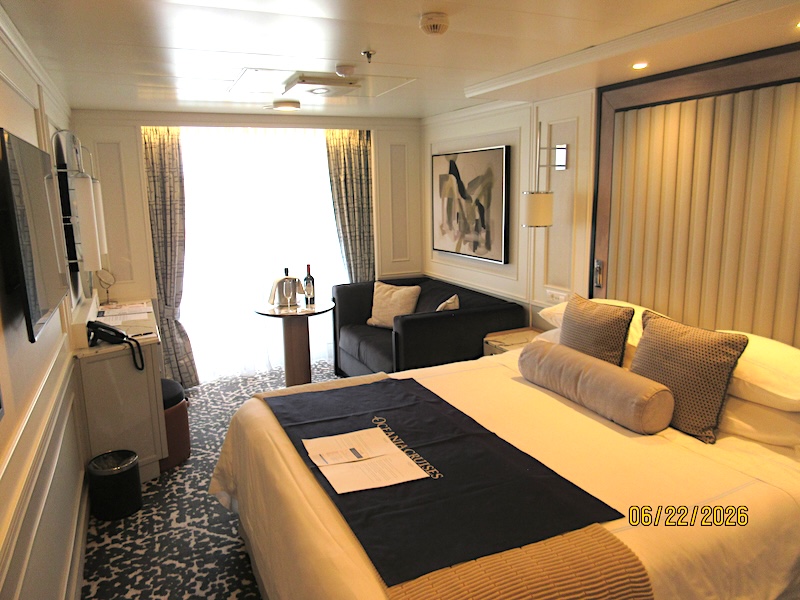
The ship has a total of 15 decks, a pool, spa, fitness center, coffee bar, library and poolside ice cream bar. Our cabin was on deck 9 and featured about 300 square feet of space, a teak veranda, seating area, oversized bathroom and walk-in shower. The color scheme was very neutral shades of beige, brown, white and navy blue. The luxurious Tranquility beds feature beautiful linens.
Our cabin features a queen size bed, small sofa, a large bath with shower and tons of storage. There is also a balcony with two arm chairs and a coffee or cocktail table. We had a bottle of champagne and red wine in our cabin when we arrived to get us started on our adventure to Alaska.
Our dinner on our first night aboard was in the Red Ginger specialty dining room. The dining room is elegantly decorated in red and black and features an Asian themed menu. For a starter I had the tempura sweet potato, avocado and mushrooms. Then there was the watermelon and duck salad followed by the entrée I selected, the seven spice lamb chops. Dessert brought a coconut mousse surrounded by lady fingers. They offered many dishes and you were encouraged to order as many items as you could eat. Some larger tables ordered lots of items and sampled a large variety.
The evenings show in the main theater was a Broadway themed show featuring six vocalists from the ships show cast. They performed a variety of Broadway shows, both vintage and current.
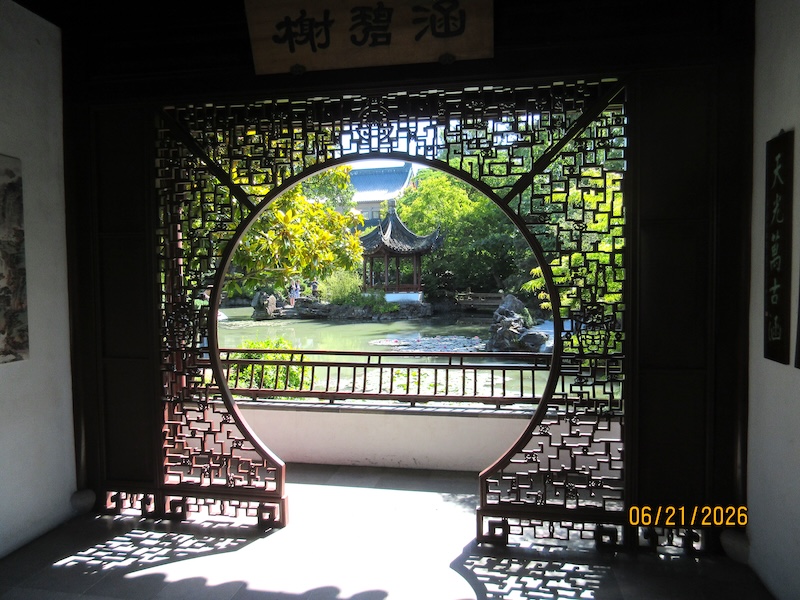
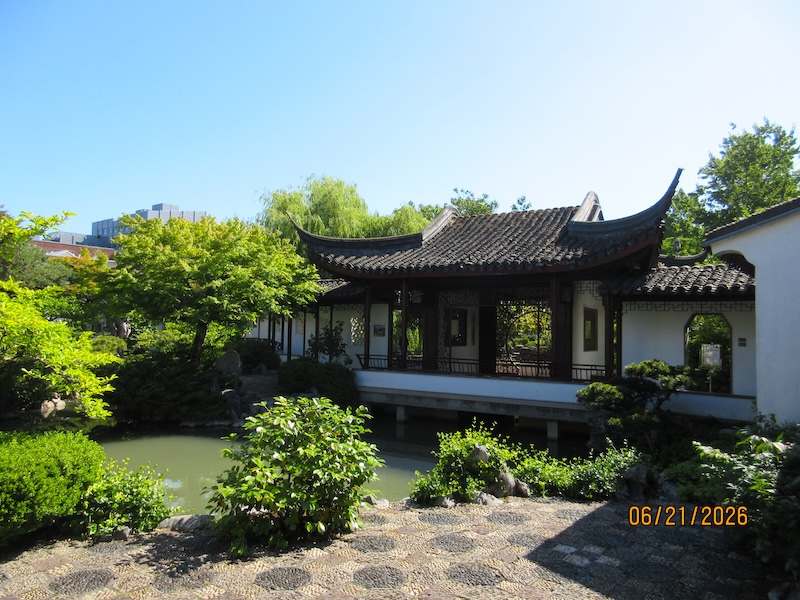
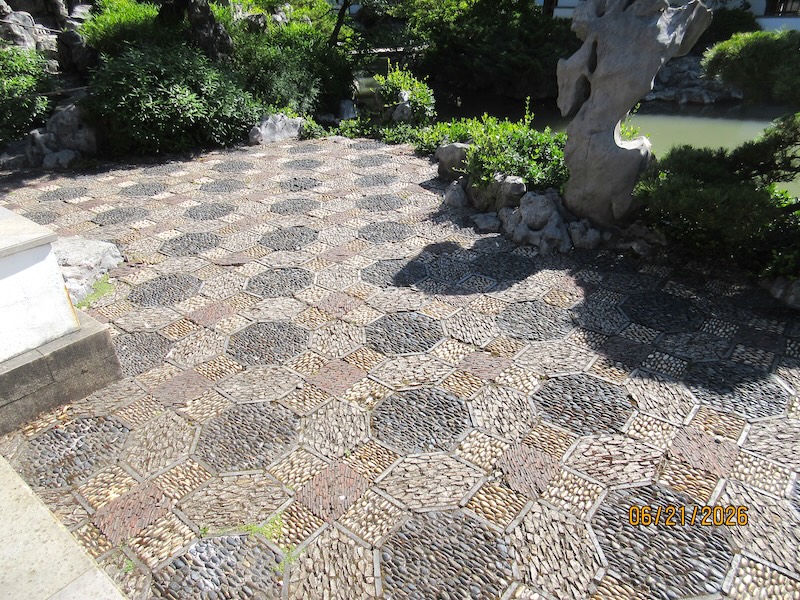
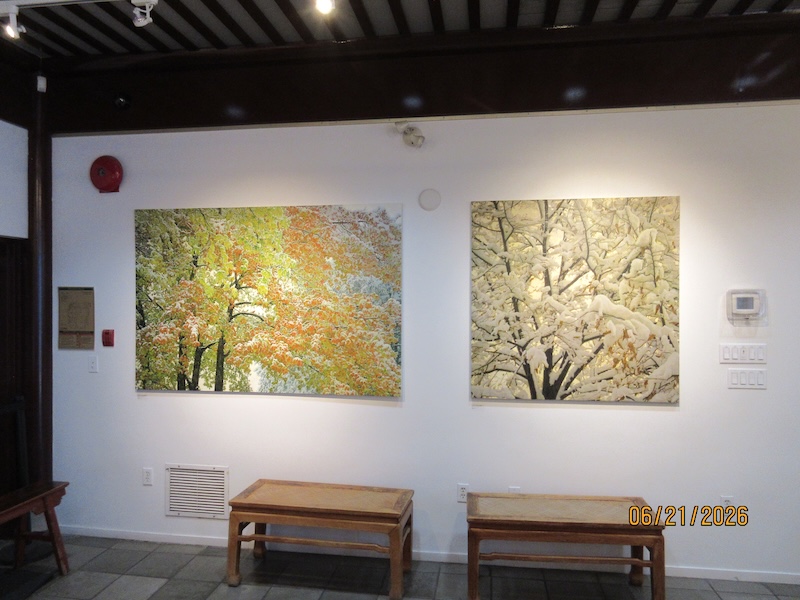
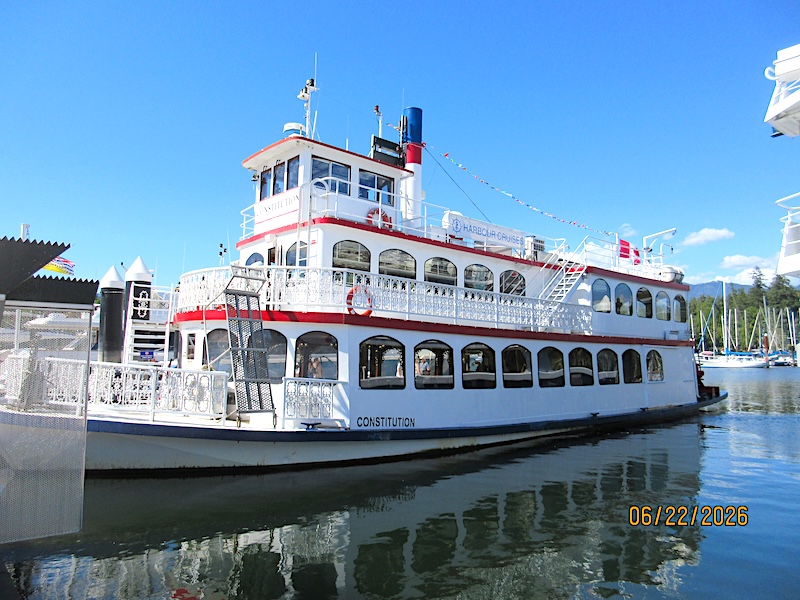
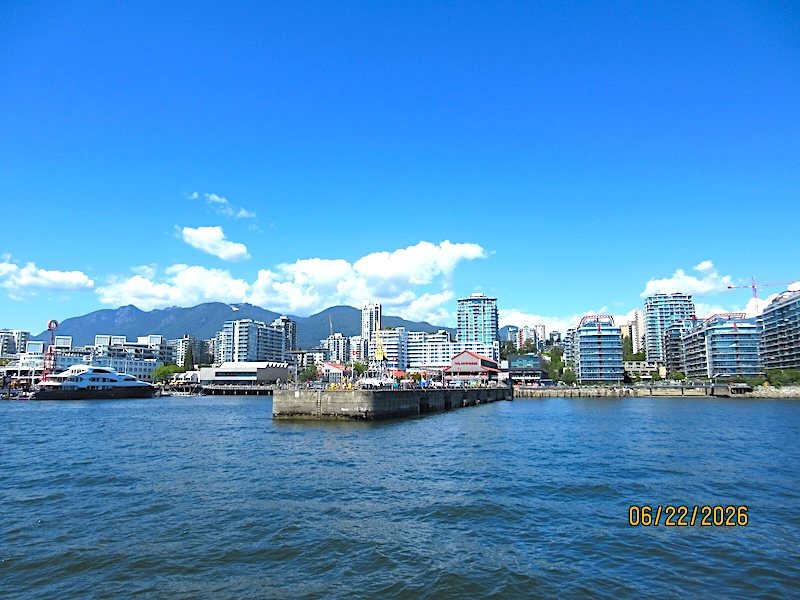
Dr. Sun Yai-Sen Chinese GardenChinese Garden Moon GateChinese GardenIntricate Stone Patios at the Chinese GardenArt Exhibit at the Chinese GardenThe Constitution Paddle wheelerNorth VancouverBreka Bakery and CafeMore PastriesMark, Kent and Bryan
Happy Father’s Day!
After breakfast in our hotel, we ventured out in a Lyft to China Town to visit the Dr. Sun Yai-Sen Chinese Park and Garden which our neighbor and friend Lois had told us about. Built in 1986, the Ming Dynasty-style garden-home is the first of its kind to be built outside of China. A collaborative effort of community members, the Canadian Government, and the People’s Republic of China, made this park and garden possible. They strive to bring together Chinese arts and culture through educational and public programs.
The grounds of the Chinese Garden encompass many walled garden spaces with ponds, volcanic rocks, meandering paths and several rooms. Each room has a special purpose, like a study for brush painting, a tea room, an art studio gallery, gift shop and decorative arts. Many of the buildings and rocks were brought in from China to make the experience as authentic as possible. Next to the Chinese Garden is a free public park with gravel paths, beautiful landscaping, a pond and several shade structures.
After visiting the garden and park Mark decided to take a little walk around the neighboring streets while Kent rested in a chair on the street corner. Mark got more than he bargained for and was suddenly transported back to his college days passing skid row in Los Angeles on his way to school. In one short block there were homeless people, drug deals taking place, people urinating on the sidewalk, people drugged out in the alley while others rifled through their belongings looking for money, bone thin elderly people sleeping in wheelchairs and more. Definitely not the China Town I expected to find in Vancouver.
There was a World Cup soccer match taking place a few blocks away so many of the streets were already closed off for the day creating traffic problems. We headed back to our hotel for a rest.
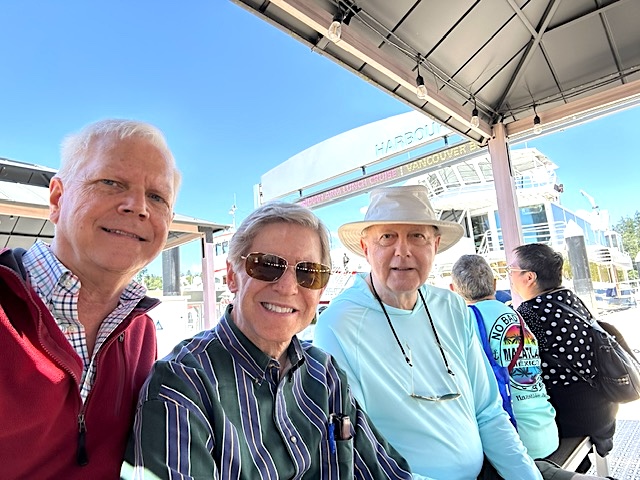
In the afternoon, we took a 60-minute harbor cruise on a paddlewheel boat called the Constitution with our friend Bryan. We enjoyed the afternoon sunshine as we passed Stanley Park, the downtown skyline, the historic Gastown, North Vancouver and the North Shore Mountains.
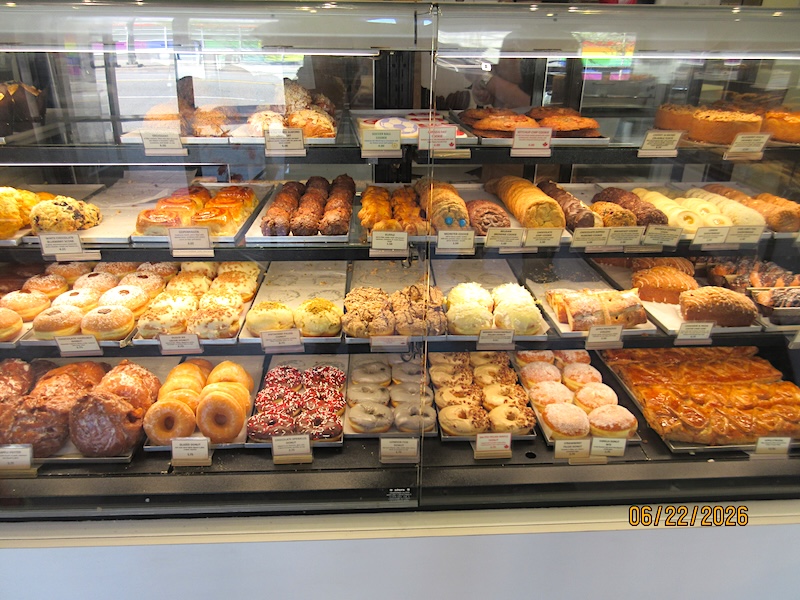
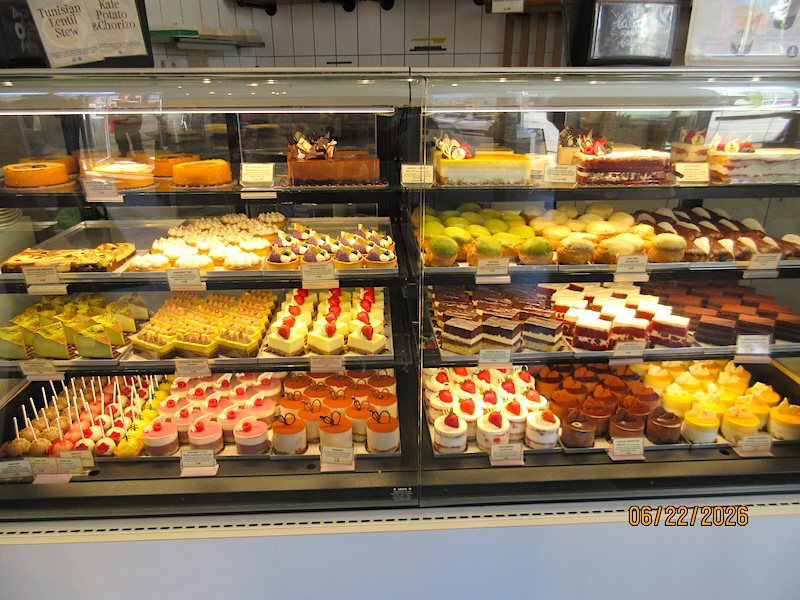
As we walked back to our hotel from the harbor cruise, we stopped at one of Bryan’s favorite bakeries called Breka Bakery and Cafe for a sweet pick-me-up treat. Bryan enjoyed a White Chocolate scone; Kent had a cheesecake brownie crunch and Mark enjoyed a pistachio brownie crunch. All delicious!!
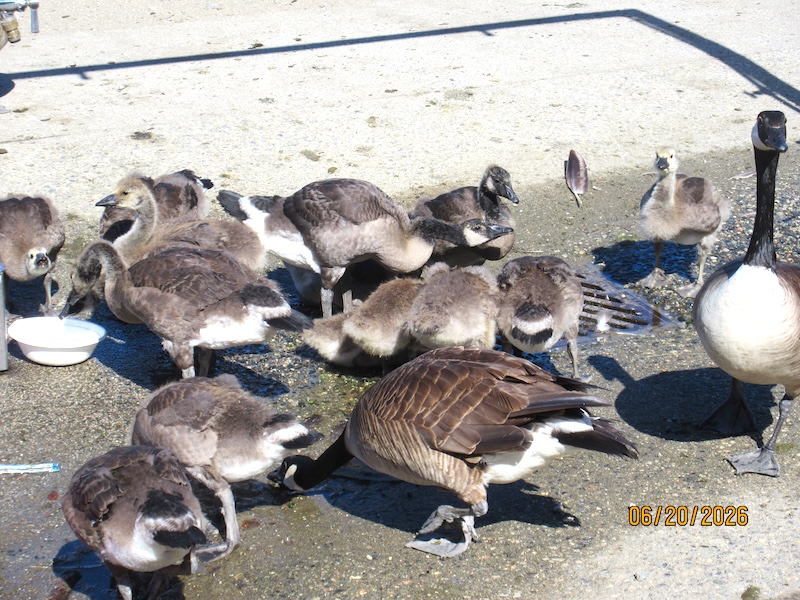
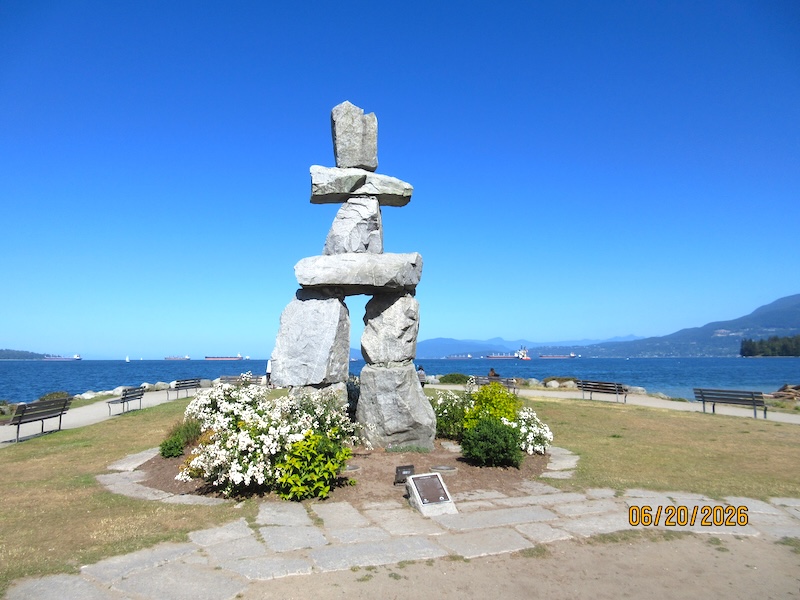
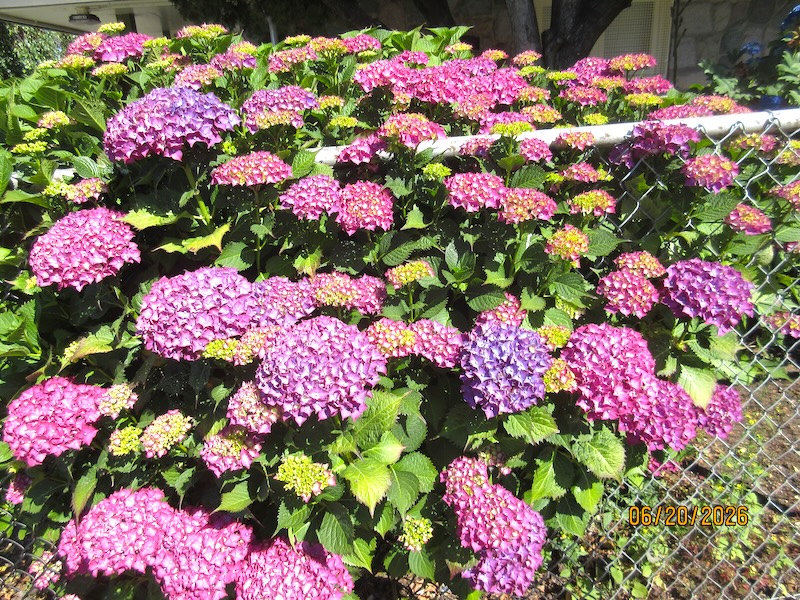
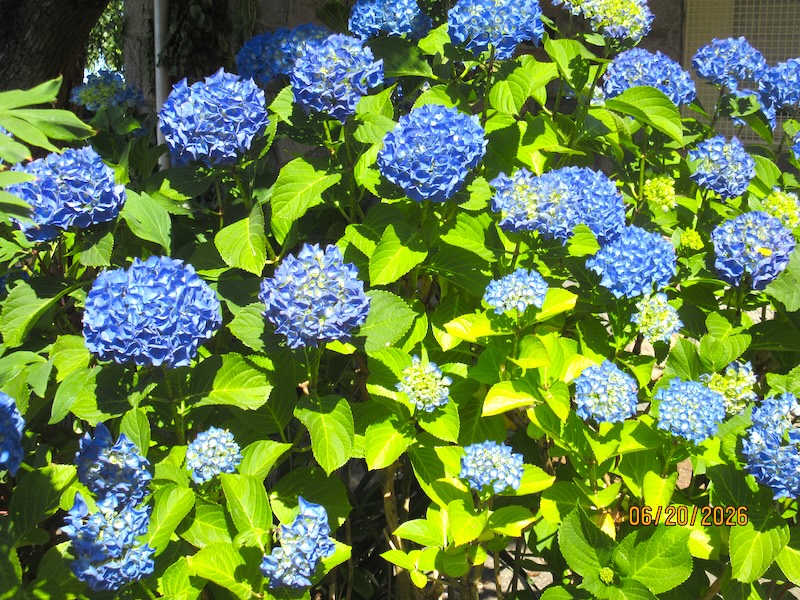
English Bay Waterfront in the MorningCanadian Geese on the WaterfrontArtistic Monument on the WaterfrontPink HydrangeaBlue HydrangeaOur Dear Friend BobThe Evening WaterfrontSunset Over Englishh Bay
This morning we had breakfast at our hotel overlooking the beautiful English Bay. The hotel serves everything from a simple muffin to oatmeal, pancakes to eggs benedict and more. It was a beautiful morning with daily temperatures ranging from a low of 56 to a high of 68.
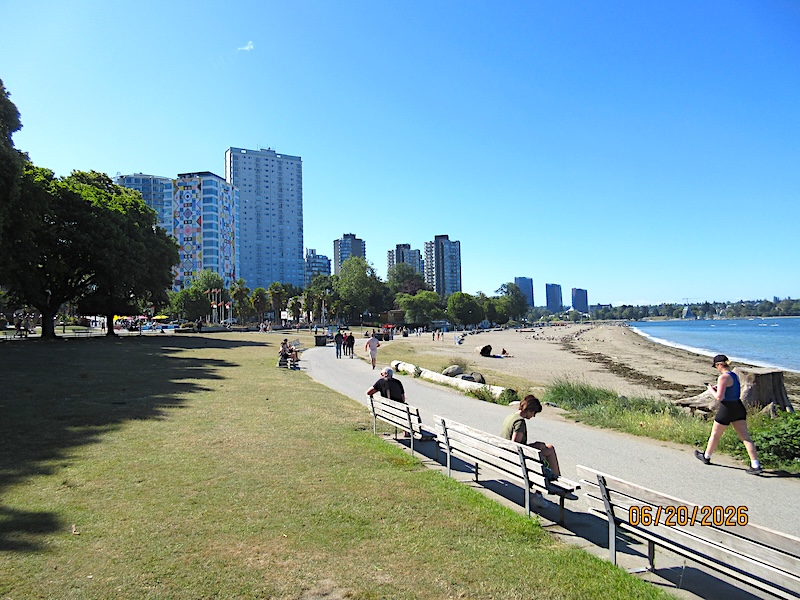
After breakfast Mark took an hour long walk along the English Bay. The paved boardwalks were filled with walkers, joggers, people exercising, walking dogs and just enjoying a summer Saturday morning. The sand and grassy hillsides were busy with young Canadian Geese looking after their chicks. Beautiful spring flowers like hydrangea are blooming all around town.
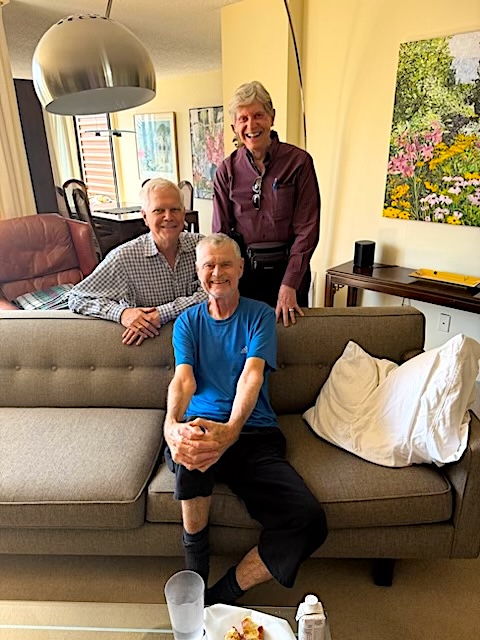
At 10:45am our friend Eugene walked over to the hotel to escort us to his and Bob’s apartment a few blocks away. Bob is a dear friend that Kent met while living in Montreal in the 1970’s and they have been friends ever since. Bob moved to Vancouver about 20 years ago from Toronto for a better client. Bob met Eugene in Hawaii in 2003.
Bob has been undergoing some chemotherapy and radiation treatments which he will complete on Monday. Eugene has been a wonderful caregiver to him and we wish him a speedy recovery.
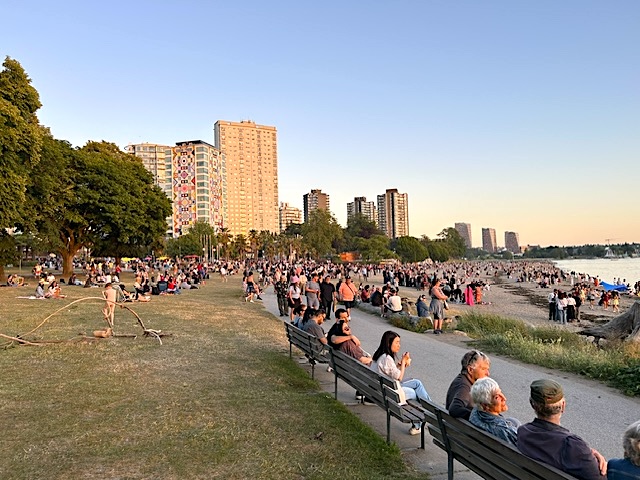
This afternoon took Mark on another walking tour around one of the shopping streets while Kent worked on his long list of emails. The beach in front of our hotel was packed with people all afternoon and evening. Lots of people riding scooters and bicycles. Here in the west end residents can adopt parkway planters and create beautiful flower gardens where grass may once have been. Some of the gardens are just beautiful with an array of colorful flowers.
This evening our long-term friend Bryan took us to a local Italian restaurant called Robba Da Matti. Bryan is another transplant that Kent met while living in Montreal and they have remained friends for the better part of fifty years. Bryan taught accounting here at the local university but has since retired.
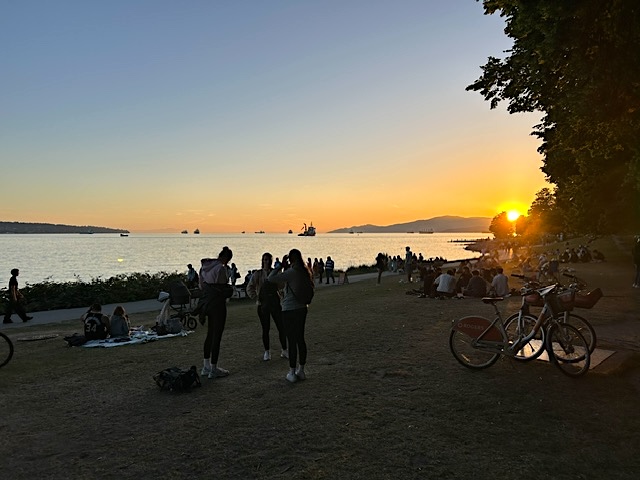
After returning to our hotel from dinner we walked across the street and found a bench to people watch along the edge of English Bay. The long days of June mean that the sun does not set until after 9:00pm and it is still light until nearly 10:00pm. Even at 9:00pm the waterfront is busy will all types of people enjoying the summer nights.
We have been to Alaska twice before, but I thought that it might be a familiar place for Kent to restart his travels after his heart attack last July. In August of 2007 my parents celebrated their 50th wedding anniversary and took my brother and sister-in-law, Kent and me on a seven-day Alaska cruise. Then in 2022, Kent and I took an Alaska cruise and land tour which ended up being 29 days in length. While in Dawson City in the Yukon Territory we tested positive for Covid and had to quarantine for ten days before being able to fly back to the United States.
This year, our flight on Alaska Air was scheduled to depart San Diego at 10:09am arriving in Seattle at 1:13pm. We then departed Seattle at about 3:30pm bound for Vancouver, arriving about 4:30pm. The airports were packed with families and travelers of all sorts, making it difficult to even find a chair to sit in. Even with the crowds, our flights were only delayed a short amount of time. We arrived in Vancouver shortly before 5:00pm. With the airports new automated machines, the process of getting through the customs hall was quick and efficient.
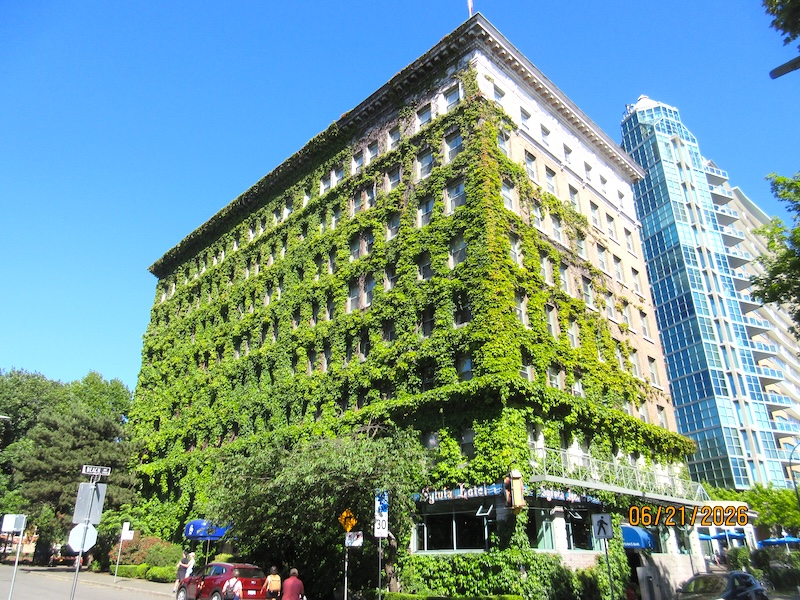
On English Bay and adjacent to Stanley Park, our hotel for the next three nights was the Sylvia Hotel. The Sylvia Hotel opened its doors on May 3, 1913 as a 77-unit apartment building. It was the tallest building in Vancouver at the time and attracted affluent tenants. Through the decades the Sylvia transitioned to shorter term accommodations while still maintaining some permanent residents. During World War II some rooms were even used to lodge English Bay’s Merchant Marine crews. In 1975 the city of Vancouver designated the Sylvia a heritage building, ensuring its survival for many years to come. Today it remains one of the few publicly accessible heritage buildings in Vancouver.
Since our last visit to the Sylvia in 2022, they have been renovating the guest rooms. Our room has a new bathroom with deep soaking tub, shower, marble floor, new vanity and toilet. The room was freshly painted with new carpeting, paint and drapes. They have done a nice job to modernize the rooms.
After we settled into our room, we met up with old time friends Ken and Will in the hotel restaurant for drinks and dinner. Will had a career with Air Canada and has known Kent since the late 70’s. Ken worked in the healthcare industry. They have been together for 25 plus years and both are now retired. Even when you don’t see good friends often, you can just pick up where you left off and it seems like no time has passed.
Vancouver began more than 10,00 years ago with territories of the Squamish, Musqueam and Tsleil-Waututh peoples. The modern city, originally named Gastown, was built around a tavern near the Hastings Mill and dates back to 1867. The name Vancouver came about after a deal with the Canadian Pacific Railway in 1886 when the railway expanded west. George Vancouver, who the city was named after, was a British naval officer who had explored and charted the North West Pacific Coast between 1791 and 1795. When Vancouver was incorporated in 1886, it had a population of 1,000. Vancouver is now a city of about 665,000 inhabitants, while the greater Vancouver metro area has a population of 2.6 million people. The city is the most ethnically and linguistically diverse cities in Canada with more than 50% of its residents belonging to a minority group.
Mark, Kent and Sandy at the Minuteman Missile Visitor Center
Minuteman Missile Visitor Center Display
Badlands National Park
Badlands National Park
Badlands National Park
Badlands National Park
Badlands National Park
Badlands National Park
Badlands National Park
Badlands National Park Visitor Center
Wall Drug Store, Wall, South Dakota
Kent at Wall Drug Store
Mark at Wall Drug Store
This day we toured the Minuteman Missile Visitor Center in Philip, South Dakota. During the Cold War, a vast arsenal of nuclear missiles was placed in the Great Plains. Hidden in plain sight, for thirty years 1,000 missiles were kept on constant alert. There were 15 Launch Control Facilities that commanded and controlled 150 Launch Facilities or Missile Silos, holding Minuteman Intercontinental Ballistic Missiles. The missile site was decommissioned in 1991 but the park preserves two of these facilities in their historic state. The Minuteman Missile remains an iconic weapon in the American nuclear arsenal. It holds the power to destroy civilization, but is meant as a nuclear deterrent to maintain peace and prevent war.
Exhibits share stories of the technology that made it possible, service men and women, citizens near and far who feared the worst, the call for civil defense, and leaders at home and abroad who led the world to the brink and back.
Our next stop was at the Badlands National Park where we explored the place the Lakota named “mako sica,” meaning “land bad.” An inland sea covered this area 68-77 million years ago. Erosion of the Badlands over the last 75 million years reveals sedimentary layers of vivid colors resulting from different minerals and elements left from volcanic ash carried here by the wind from other parts of the world. Today, 244,000 acres of mystical moon-like topography of spires and pinnacles surrounded by a sea of grass are inhabited by buffalo, deer, antelope, prairie dogs and much more.
For lunch we headed to Wall, South Dakota, and a restaurant called Salty Steer. We had a choice of three sliders, a wedge salad or a mixed green salad with fresh berries, sliced almonds and poppy seed dressing. Kent, Sandy and I each tried a different dish and they were all excellent.
We then walked a block down the street to the famous Wall Drug Store. Ted and Dorothy Hustead had bought this small one room drug store in Wall, population 326 in December 1931, where they lived in the rear of the store. They decided to give this small town a try for five years and see if they could make a go of it. By 1936 business was still slow and the drug store hadn’t grown much at all. It was then that Dorothy had an idea to attract more cars that passed on the highway to the Badlands in the summer heat. She thought that if they offered cold ice water to thirsty travelers they would stop in and maybe buy something else. She had Ted post some signs along the main highway offering ice cold water for free and it worked. Before long, car after car was stopping in for the cold water and buying other items. Soon the weather changed and in addition to the ice water they offered coffee for 5 cents. Before long they were adding more roadside signs and the business began to grow by leaps and bounds.
Today, the little Wall Drug Store has about 20,000 visitors a day. They still sell coffee for a nickel and give away ice cold water. The small shop now occupies two city blocks and shop after shop filled with all sorts of food, drinks, homemade ice cream, donuts, artwork and most anything you could need.
Road Scholar hosted a farewell cocktail reception and dinner of Cordon Blue, green beans, wild rice and salad. They handed out photos that they took of the entire group at Mt. Rushmore.
Mammoth Skeleton Replicas Created from Uncovered Bones
Wind Cave Blow Hole
Mark, Sandy and Kent at the Base of Mount Rushmore with Washington Above
George Washington
Veterans and Gold Star Families
Mount Rushmore Illuminated at Night
The weather on this morning continued to be cold and wet. The previous day was one of the coldest dates recorded for the area with a high of only 56 degrees. This is in comparison to the 96-degree high a couple of days before.
On this morning we were joined by a woman by the name of Tiffany Robertson who presented the story of her and her husband, Tyler’s 5,000-acre cattle ranch. She showed us slides and explained about all the work it takes to raise cattle throughout an entire year. She discussed raising the cattle, feeding the cattle, branding the cattle, breeding the cattle and so` much more. The price of beef is up so business is good for them this year.
We then took a motorcoach to Hot Springs, South Dakota where we explored an active paleontological dig site called The Mammoth Site of Hot Springs, SD. The site boasts the largest concentration of mammoth remains in the world. We took a journey back in time when Ice Age mammoths, camels, and giant short-faced bears roamed the Great Plains of North America. More than 26,000 years ago, a sinkhole collapsed and the warm spring percolating from the bottom filled it in to create an ideal watering hole for animals to quench their thirst. The sinkhole proved to be too slippery and steep for the animals to retreat, thus creating a death trap for large Columbian and Wooly Mammoths. The sinkhole is believed to have been at least 65 feet deep and 120 feet by 150 feet wide at the surface. The entire sinkhole site is housed inside a building with elevated walkways for you to navigate above the dig site.
We saw a short ten-minute introduction film and then toured the world’s largest Columbian Mammoth exhibit and research center for Pleistocene studies. We went behind the scenes at the Mammoth Site Laboratory with the museum’s docent to learn more about specific bones, fossils and the stories behind the Mammoth’s demise.
For lunch we dined at a local motel and restaurant in Hot Springs where the owner shared some photos and stories about the town’s past and present. Lunch consisted of white bread with cold cuts, potato salad, bean salad, potato chips, soup and homemade desserts.
After lunch we headed to the Wind Cave National Park located about ten miles north of Hot Springs, South Dakota. The park was established on January 3, 1903 by President Theodore Roosevelt. It was the sixth national park in the U.S. and the first cave to be designated a national park anywhere in the world.
The cave is notable for its calcite formations known as boxwork (a honeycomb like structure), as well as its frostwork (needle like growths). Approximately 95 percent of the world’s discovered boxwork formations are found in Wind Cave. The cave is the sixth longest cave in the world with over 168 miles of explored cave passageways.
Above ground the national park includes the largest remaining natural mixed grass prairie in the United States and is home to many animals including elk, bison, coyotes, cougars, bobcats, red foxes, minks, prairie dogs and a free roaming and genetically pure herd of bison.
We did not enter the cave but instead took an interpretive walk to the natural opening of the Wind Cave to learn more about its origin and relevance to the local native creation story.
On our way back to the lodge we were able to stop by Crazy Horse and the weather was clear enough to see the mountain although not sunny. We also stopped at a turn out near Mount Rushmore where we could get a photo of George Washington’s face. By this time of day, the sun was beginning to shine and everything looked better.
After an Italian dinner at the lodge, we had a local expert who presented a talk on the natural history and creation of the Black Hills.
At last, the weather had improved and we were able to attend the lighting ceremony at Mount Rushmore. The ceremony began at 9:00pm with one of the rangers giving a ten-minute talk on anything of their choosing. Tonight, the young man was discussing freedom and democracy. The National Anthem was presented in a film and folks sang along. Next, they showed a film about the contributions and accomplishments of the four presidents depicted on Mt. Rushmore. The presidents were then illuminated to great applause. Next, the veterans in the audience and any gold star families were invited to the stage to be recognized and to retire the colors. It was a beautiful and patriotic ceremony. We headed home about 10:10pm.
Breakfast each morning was served in a hexagon shaped room called the gazebo. The breakfast buffet was very extensive featuring coffee, juice, fresh fruit, pancakes, scrambled eggs, scrambled eggs with cheese and green chilies, tortillas, salsa, bacon or sausage, pastries and muffins, cereal, bagels, toast and more.
The weather on this day was extremely different from any day we had experienced thus far. The temperature all day ranged between 49 and 55 degrees with a near constant drizzle and low clouds or fog. It was cold, dreary and a bit depressing.
After breakfast in the lodge, we headed out to Custer State Park and Wildlife Preserve in the Black Hills. The park was named after Lieutenant Colonel George Armstrong Custer who was an Army officer and Calvary commander in the American Civil War and the American Indian Wars. On June 25, 1876, Custer, while leading the Army’s 7th Calvary Regiment at the Battle of the Little Bighorn against a coalition of Western Native American tribes, was killed. Along with Custer, every soldier of the five companies he led was also killed. This event became known as “Custer’s Last Stand.”
We took an 18-mile driving tour around Wildlife Loop Road which is just a small portion of the park. The park covers more than 70,000 acres of local terrain ranging from rolling prairie grasslands to rugged mountains. The park is home to a herd of 1,500 bison, elk, coyotes, mule deer, white tailed deer, mountain goats, prairie dogs, bighorn sheep, river otters, pronghorn, cougars and feral burros. We were able to see a cluster of the burros, some deer, elk and many bison.
We enjoyed lunch at a popular lodge in Custer State Park called the Sylvan Lake Lodge. The lodge dates back to 1891 when Theodore Reder built a dam to create the lake, and his wife Elizabeth, designed the original Sylvan Lake Lodge which opened in 1893. The lodge was a popular attraction but the original structure was destroyed by fire in 1935. The current lodge was built on the site in 1937 and is beautiful.
Lunch was served in a lovely restaurant added to the hotel in 1991. Kent, Sandy and I all enjoyed a fresh salad with crispy chicken. For dessert we had a variety of lemon bars, chocolate chip cookies and date bars.
After lunch, we headed to the site of the Crazy Horse Memorial where we were greeted with fog and low clouds that completely hid any signs of the memorial. Our tour guide suggested we not visit today, but wait for better weather tomorrow. The memorial depicts the Native American Chief Crazy Horse. This enormous sculpture, when completed, will measure 641 feet long and 563 feet high. The head of Crazy Horse, which was completed in 1998, measures 87 feet high while the president’s heads on Mount Rushmore measure 60 feet in height. Crazy Horse’s outstretched arm, which they are working on now, measures 263 feet in length with an index finger of nearly 30 feet in length. It was begun in 1948 by Polish American sculptor Korczak Ziolkowski, who worked on it until his death in 1982. His family continues the work today with only private funding and no tax dollars. Because of its size, it could take many more years to complete.
We visited the Crazy Horse Visitor Center and five Museums where we learned about the campus repository for Native American artifacts, arts and crafts, and the Native American Educational & Cultural Center. The visitor center is comprised of many buildings and features a wide variety of things as well as dance performances, visiting artists and events.
After a pot roast dinner in the lodge, we were joined by a local expert who shared with us stories and dances that are representative of the local Indigenous peoples. Stephen Yellowhawk along with his two sons shared with us their life stories, native dress and dances.
We had hoped to make it back to Mount Rushmore this evening for the light show, however, the poor weather conditions required us to cancel once again.
Mark, Sandy and Kent at Mount Rushmore in the Bright Sun
Scale Model in the Artist’s Workshop
Map of the Tour Stops and the Stories to Hear on the Voice Wand
Mount Rushmore
Bust of the Sculptor of Mount Rushmore
Exhibit at the Journey Museum
TeePee or Tipi at the Journey Museum
Beaded Dress Display at the Journey Museum
Bird Exhibit at the Journey Museum
After breakfast at the lodge, we boarded a motorcoach for a field trip to explore the United States’ Shrine of Democracy: Mount Rushmore National Memorial. It is a colossal sculpture carved into the granite face of Mount Rushmore. The sculptor, Gutzon Borglum, named it the Shrine of Democracy, and oversaw the execution from 1927 to 1941 with the help of his son, Lincoln Borglum. The sculpture features four, 60’ tall heads of four U.S. Presidents: George Washington, Thomas Jefferson, Theodore Roosevelt and Abraham Lincoln, respectively chosen to represent the nation’s foundation, expansion, development and preservation. Furthermore, Washington led the United States to win independence from Great Britain, Jefferson was the author of the Declaration of Independence, Roosevelt the “trust buster” ensured the rights of working people and was instrumental in building the Panama Canal, and Lincoln led the country through the Civil War. Mount Rushmore attracts more than two million visitors annually to the memorial park which covers 1,278 acres. The elevation is approximately 5,725 feet above sea level.
Borglum chose Mount Rushmore because of its southeast exposure for maximum sun exposure. South Dakota Senator, Peter Norbeck, sponsored the project and secured federal funding for it. Construction began in 1927 and the faces were completed between 1934 and 1939. After Gutzon Borglum died in March of 1941, his son Lincoln took over as leader of the construction project. Each president was originally to be depicted from head to waist, but lack of funding forced construction to end on October 31, 1941, and only Washington’s sculpture includes any detail below chin level.
Gutzon Borglum and some 400 workers sculpted the colossal 60-foot-high carvings to represent the first 150 years of American history. The chief carver of the mountain was Luigi Del Bianco, an artisan and stonemason who immigrated to the U.S. from Friuli in Italy. Luigi was chosen for his understanding of sculptural language and his ability to imbue emotion in the carved portraits. The carving involved the use of dynamite, followed by the process of “honeycombing,” where workers drill holes close together allowing small pieces to be removed by hand. In total more than 410 tons of rock were blasted off the mountainside. The image of Jefferson was originally intended to appear to the right of Washington, but after the work began the rock was found to be unstable, so the work on Jefferson was dynamited and a new figure was sculpted to Washington’s left. In total, the project cost $989,992.32, the equivalent of about $21 million today. Nick Clifford, the last remaining carver died in 2019 at the age of 98.
While at Mount Rushmore, Sandy and Mark chose to walk on the Presidential Trail with interpretive signage along the way illuminating more about the monument, its construction and the artist whose vision produced America’s most iconic symbol. The trail took us to two of the artist studios where a one-inch to one-foot scale model is kept. Kent chose to stay on the main observation platform where he could listen to all of the trail marker information from the comfort of a bench.
The entire memorial is beautifully maintained, immaculately cared for and easily navigable. The facility includes a gift shop, a restaurant, observation deck, amphitheater, museum hall and more. All of these spaces spread the visitors out making it not seem too crowded.
After our visit to Mount Rushmore, we headed to Rapid City, chosen as the “Most Patriotic City” by USA Today readers. There we had time on our own to visit the 20-square-block section of the historic downtown with life-sized bronze statues of all of the past presidents along its streets and sidewalks. This was started in 2000 to honor the legacy of the American presidency. We had been here several days ago so we spent our time having lunch at an Irish Pub and exploring a large antique mall.
After lunch we set out for a field trip to the Journey Museum where we learned more about the Black Hills and surrounding area. The Journey Museum brings into focus the story of billions of years of eruption, exploration, evolution, conflict and change. A tectonic shift deep inside the earth 2.5 billion years ago violently thrust up the land now known as the Black Hills into being. One of the oldest mountain ranges in the world, they have been worn down by the ravages of time from a height that was greater than 15,000 feet, thereby exposing the fine granite suitable for carving images into rock. Once on the edge of a great inland sea, this part of what is now the Great Plains was home to ancient dinosaurs. Prehistoric people came here when ice still held sway over most of North America and it would be another 10,000 years before the arrival of current Native Americans. The museum explores the geology, paleontology, archaeology as well as stories of the pioneers, Native American culture and the history of the Black Hills.
Dinner this evening was served at the lodge and included turkey, mashed potatoes, mixed vegetables and gravy as well as a green salad. For dessert we had an apple crisp.
We were scheduled for a ride back to the Mount Rushmore amphitheater to see an inspirational 45-minute program focused on the presidents, patriotism and the nation’s history. Unfortunately, due to fog, rain and possible thunderstorms we had to cancel. They said that we would try again the following day.
After breakfast in the lodge, we boarded a motorcoach to the High Plains Western Heritage Center in Spearfish. S. D. Along the way we drove through Sturgis which hosts an annual motorbike rally. Attendance at these events can reach nearly 700,000 people over 10 days and generates some $800 million in annual revenue. Typically, Sturgis only has a population of about 7,000 residents. The first rally was held by Indian Brand Motorcycle riders in 1938. The founder was Clarence Hoel who purchased an Indian motorcycle in 1936. All sorts of entertainers are known to perform at the rally and it’s not unheard of to hear about naked women in body paint, prostitution, drunken fights, stolen motorbikes and many accidents and even fatalities.
The Heritage Center is a five-state regional museum to honor the Old West pioneers of North Dakota, South Dakota, Montana, Wyoming and Nebraska. The 20,000 square foot museum included exhibits on the stagecoach, a turn of the century kitchen, saddle shop and blacksmith shop, forestry, mining, ranching and rodeo displays along with a furnished log cabin, rural schoolhouse and antique farming equipment. In the center’s theater we saw a one-woman performance by Joyce Jefferson, on three of South Dakota’s early pioneer black women: Sarah Campbell, Lucretia Marchbanks and Mary Kercherval. These black women were the first to file a gold claim in the Black Hills, to own a local hotel and property.
At the Heritage Center, a buffet chuckwagon lunch was catered by a local restaurant. The lunch included a green salad, pasta with a beef ragu, vegetable medley and dessert.
After lunch we visited the historic town of Deadwood where our guide taught us about Deadwood. Named after its dead trees found in the gulch this city had its heyday from 1876 to 1879 after gold deposits were discovered there. At its height, the town had a population of about 25,000, attracting the likes of Wyatt Earp, Calamity Jane, Seth Bullock and Wild Bill Hickok. Deadwood was known for its lawlessness, murders and brothels as prostitution was in high demand.
The town is a National Historic Landmark District today for its well-preserved Gold Rush era architecture. The town includes five unique history museums and a population of 1,350 or so residents.
After visiting the town of Deadwood, we headed a short distance to the town of Lead, pronounced “Leed.” Lead was founded in 1876 after the discovery of gold and named Lead for the leads or lodes of the deposits of valuable ores. It is the site of the Homestake Mine, the largest, deepest (8,240 feet) and the most productive mine in the Western Hemisphere before closing in January of 2002. By 1910, it was the second largest town in South Dakota with 8,382 residents.
Since the mine closed it has been used as a laboratory 4,850 feet underground. We were joined by staff of the Education and Outreach Program for the Sanford Underground Research Facility (SURF) who presented information on the history of the mine, its significance and how an historic mine has become one of the leading state-of-the-art scientific neutrino labs in the world. A neutrino is a subatomic particle that has very little mass and no electrical charge. It plays a significant role in nuclear reactions within stars and contribute to the formation of elements. Researchers from around the world come to this lab to work on a variety of experiments and conduct research.
We enjoyed a salad bar dinner at the lodge with chocolate chip cookies for dessert.
After dinner we were joined by a local expert for a look into the management and health of the forests of the Black Hills. He discussed historical photos of the forests compared to the forests of today. He spoke about the pine beetles and the extensive damage they have done to the forest.