August 11, 2019

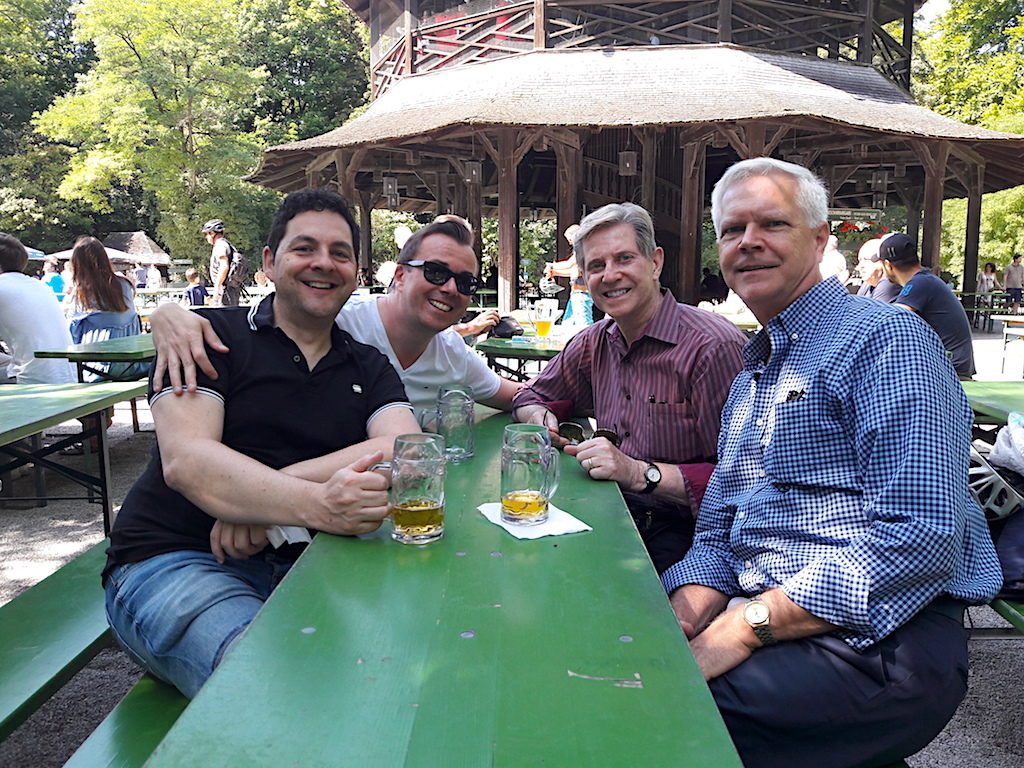
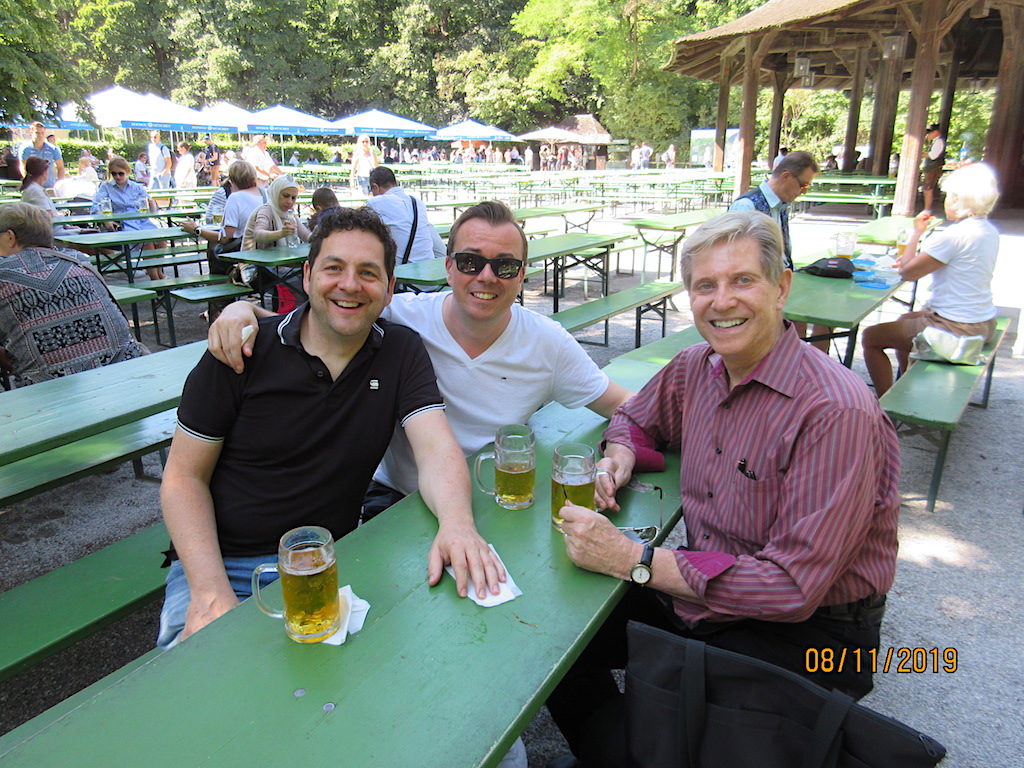
Alain, Matthias and Kent at the beer garden

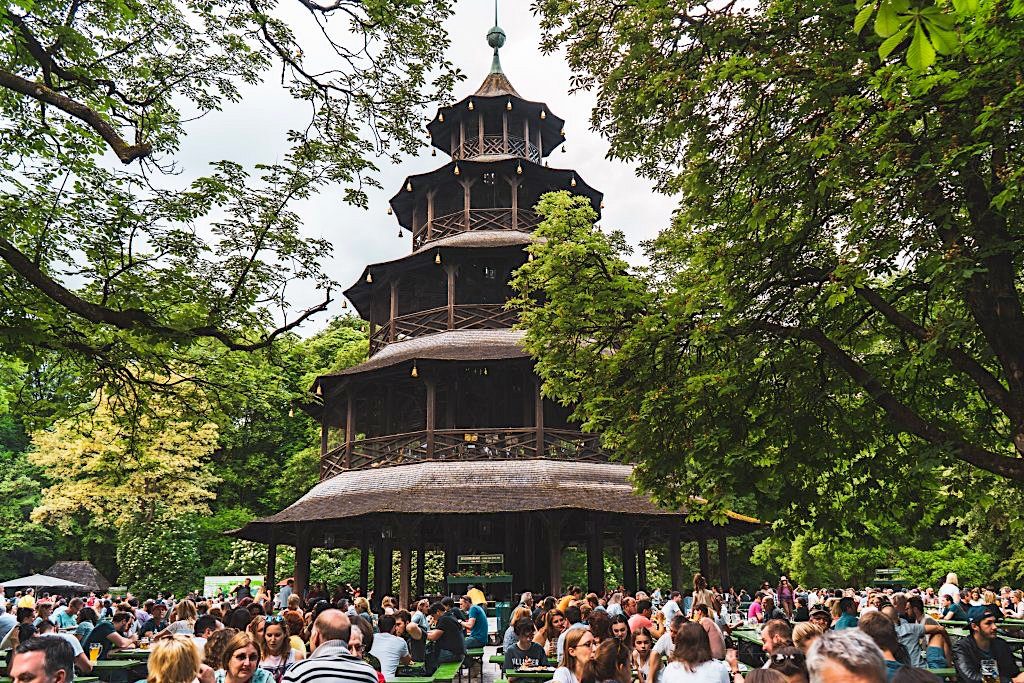
English Garden Pagoda Style Tower

All of us at the Beer Garden

This morning we had breakfast with Alain and Matthias at our hotel before checking out. The boys had driven from Stuttgart so they had a car and drove us to the English Garden for a walk and beverages at the Chinese Tower. The Tower is a multi-level structure that serves as the centerpiece for one of the cities most beloved beer gardens. The beer garden is the second largest in Munich, offering over 7,000 open-air seats at tables and benches surrounding the tower. During good weather, the tower houses a band on the second floor playing local tunes.

After a visit to the park the boys drove us to the airport Hilton where we were to meet up with our group for the trip to Bolzano, Italy. We arrived about 2:00pm and had to wait a short while for a room to be ready. Christine meet up with us in the lobby and helped speed up the process of getting our room.

At 7:00pm we met up with our group of 20 including Kent and Christine Zimmerman, our program managers for the next couple of weeks. The group consists of mostly Americans from California to Virginia, and a couple of Canadians We walked a short distance to a local Bavarian restaurant for dinner. We started with cheese platters and wine followed by suckling pig with potato dumplings, pork knuckles, potato salad, salmon and more. This was followed by more drinks, deep fried and sugar-coated apple slices, ice cream, plum and apricot dumplings. All delicious but way too much to eat.

August 10, 2019 Munich, Germany

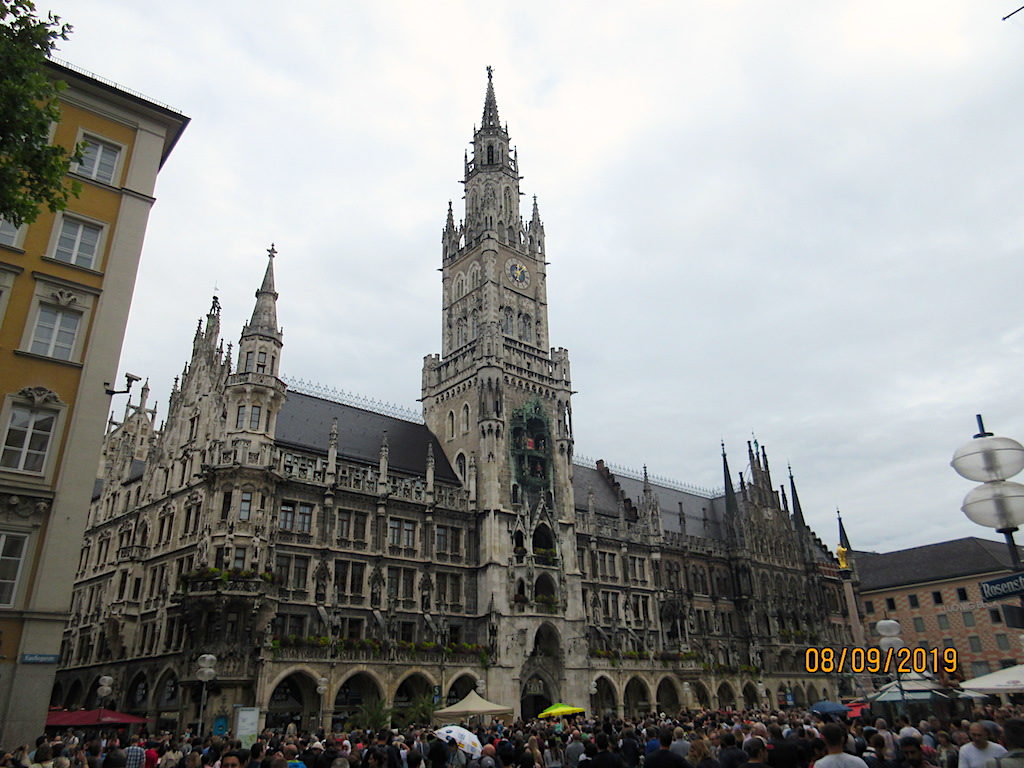
City Hall and the Glockenspiel

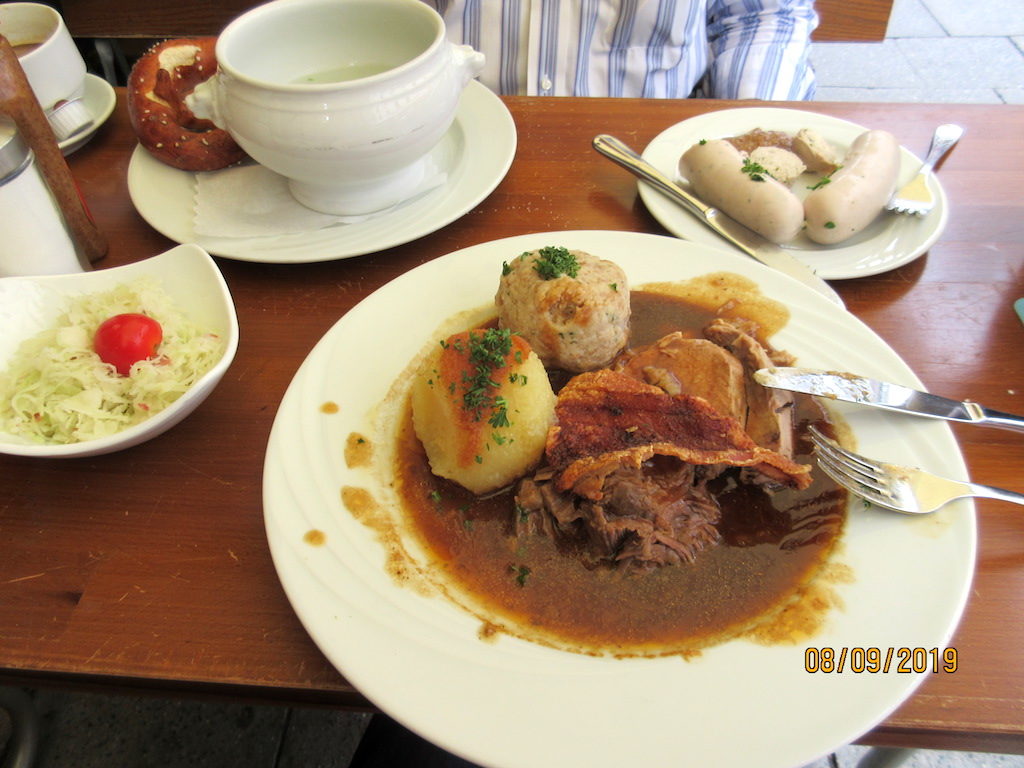
Roast Pork and Dumplings

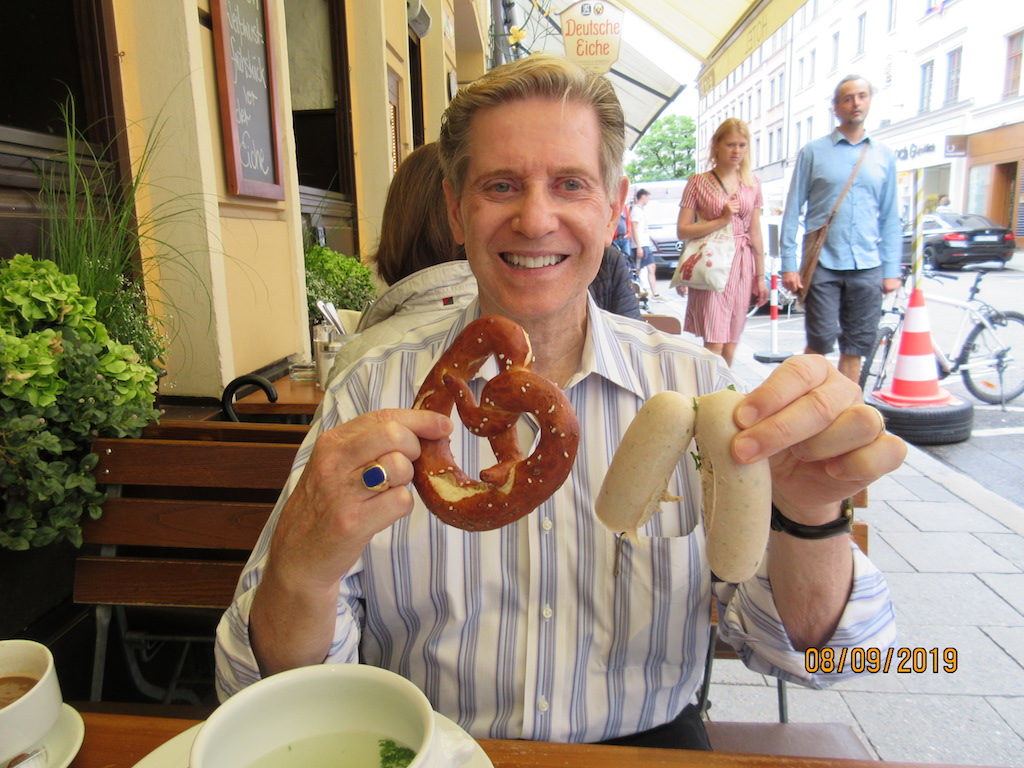
White Sausage and Pretzel

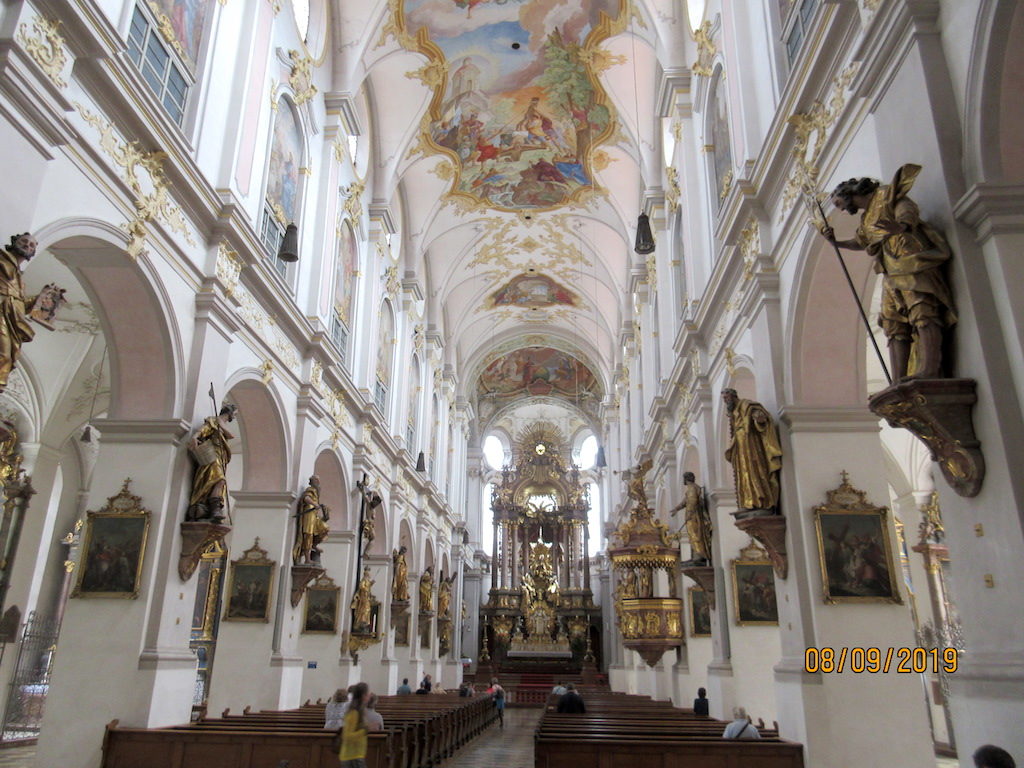
St. Peters Church Interior

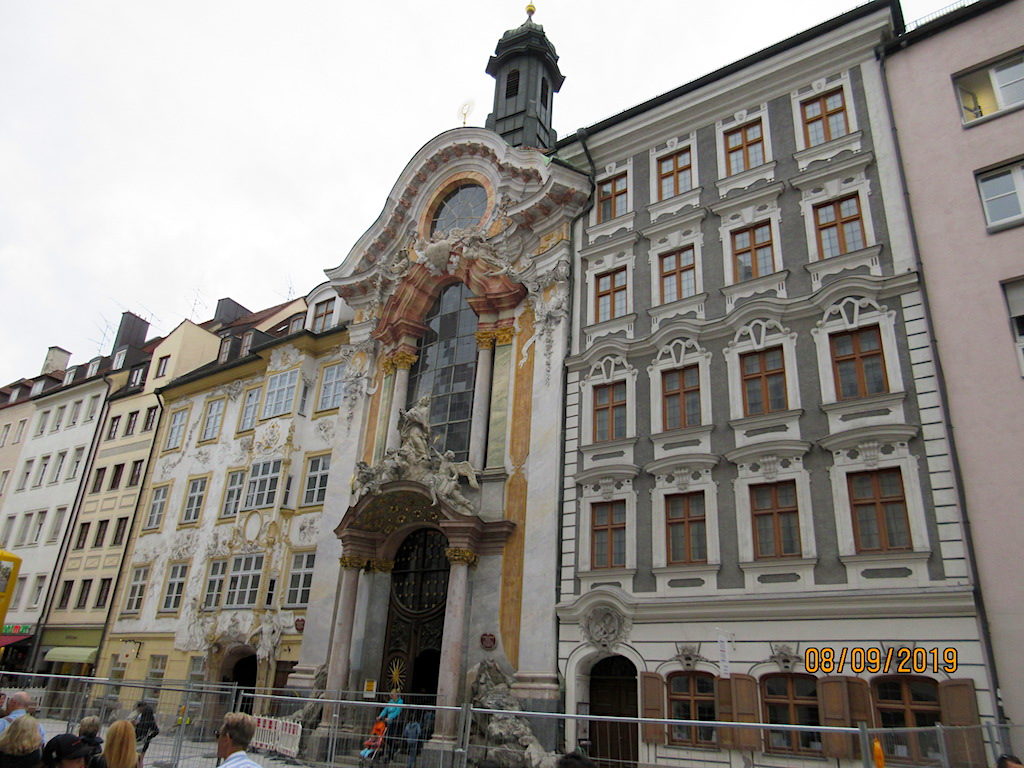
Asam Church Exterior

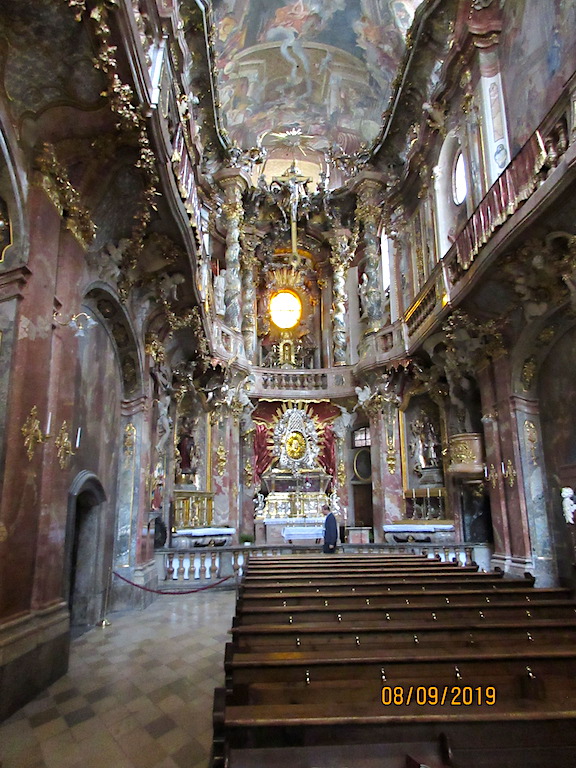
Asam Church Interior

We had another restless night, still adjusting to the time change of nine hours from home. After a morning of mostly light rain it dried out and we ventured out to the Marienplatz to catch the Glockenspiel clock performance. The Marienplatz is the main town square housing the city hall. The ornate City Hall building includes the Glockenspiel in its tower.

The Glockenspiel dates from 1908 and consists of 43 bells and 32 life sized figures. The top half of the Glockenspiel tells the story of the marriage of Duke Wilhelm V to Renata of Lorraine. In honor of the happy couple there is a joist with life sized knights on horseback representing Bavaria and Lothringen. The lower part of the Glockenspiel shows dancers dancing the coopers dance. The show lasts between 12 and 15 minutes depending on the tune played that day. At the end of the show, a very small golden rooster at the top of the Glockenspiel chirps three times, marking the end of the spectacle.

We then visited St Peter’s Church before stopping at the Deutsche Eiche (German Oak) Hotel and Restaurant for lunch. The hotel is one of the most historical meeting places in the Munich art scene and gay village. The hotel consists of 32 rooms, has a restaurant, roof top deck and bathhouse. For lunch, Mark tried the roast pork with dark beer sauce topped with pork rind, a potato dumpling, a bread dumpling and the bacon cabbage salad. Kent enjoyed 2 Munich sausages with sweet mustard and a pretzel. The sausages were short, fat and white in color while the mustard was sweet and delicious.

Our next stop was at one of the most ornately decorated churches in the city of Munich called St. Johann Nepomuk or better known as the Asam Church. The church was built from 1733 to 1746 by brothers, Egid Quirin Asam, a sculptor, and Cosmas Damian Asan, a painter, as their private church. The church is small in size measuring only about 75 feet by 25 feet. It is extremely gaudy with ornamentation everywhere. We were not allowed to access the church as there is a wrought iron gate not far inside the church that you can only look through. Even so, it was quite a site to see.

In the afternoon our friends Alain and Matthias from Stuttgart arrived at our hotel. We headed out to a street fair where they had beer and food stands out in the street and folks gathered to have drinks with friends in the street. As it was raining lightly, we decided to stop in at a local café where Matthias and Alain had a lunch snack and we had coffees and a piece of cake. Afterwards we walked back to our hotel for a short rest before heading out to dinner.

We met Alain and Matthias on the World Cruise on Holland America Lines in 2013. We visited them in Stuttgart in June, 2013. Next, we met them in Paris in October of 2015; Lucerne, Switzerland, in October, 2016; and London in May, 2018. It is wonderful to be able to catch up with these fellow travelers whenever we can.

For dinner the four of us headed to the Viktualienmarkt in the center of Munich which is a daily food market. It features about 140 stalls and shops offering flowers, exotic fruits, game, poultry, spices, cheese, fish, juices and more. Here we dined at the Laurin Restaurant on a charming and pleasant outdoor patio. When we arrived, Kent spotted our friends and program managers, Kent and Christine Zimmerman, for our upcoming trip to Bolzano, Italy.

For dinner Alain, Matthias and Mark enjoyed an excellent veal schnitzel with a cranberry preserve and potato salad. Kent had the cheese plate with a variety of cheeses, nuts, grapes and crispy dark bread, along with regular sliced bread and butter. It was a very nice dinner and we enjoyed catching up with Matthias and Alain.

August 9, 2019 Munich, Germany

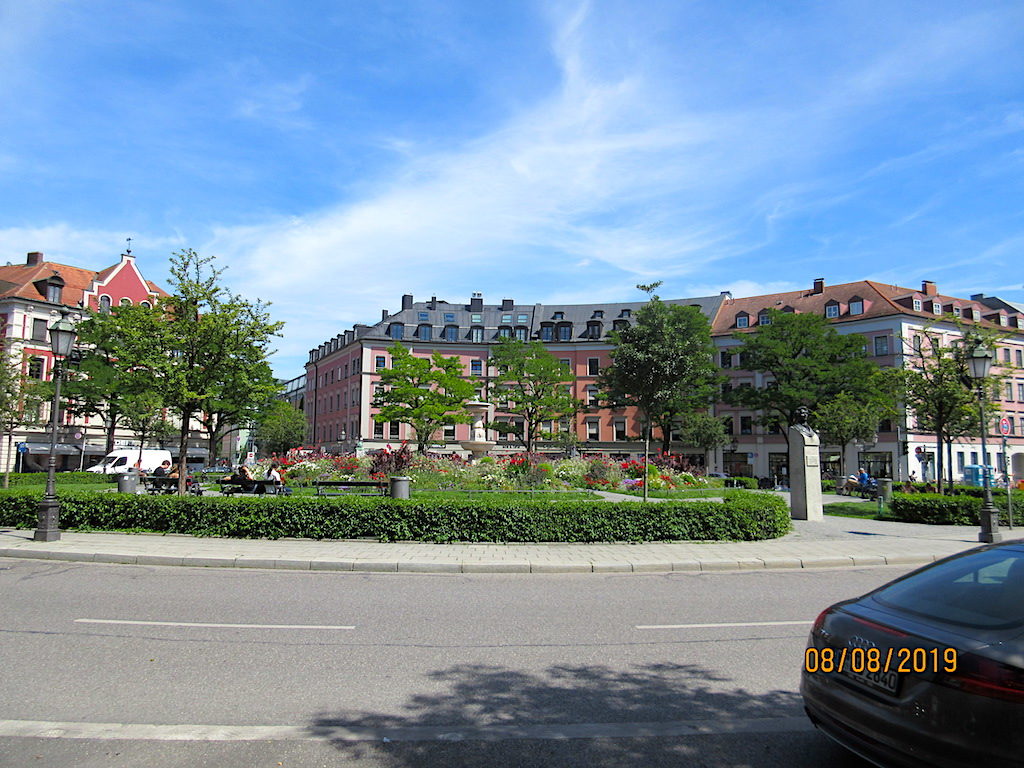
Gartnerplatz Circle

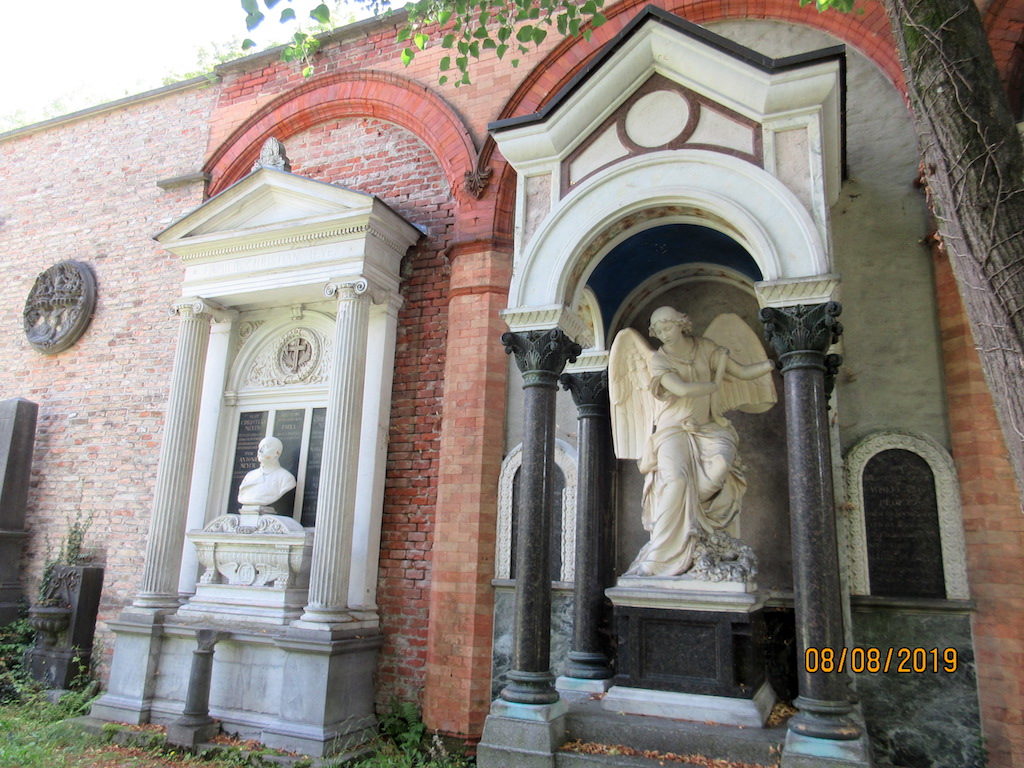
Cemetery Monuments

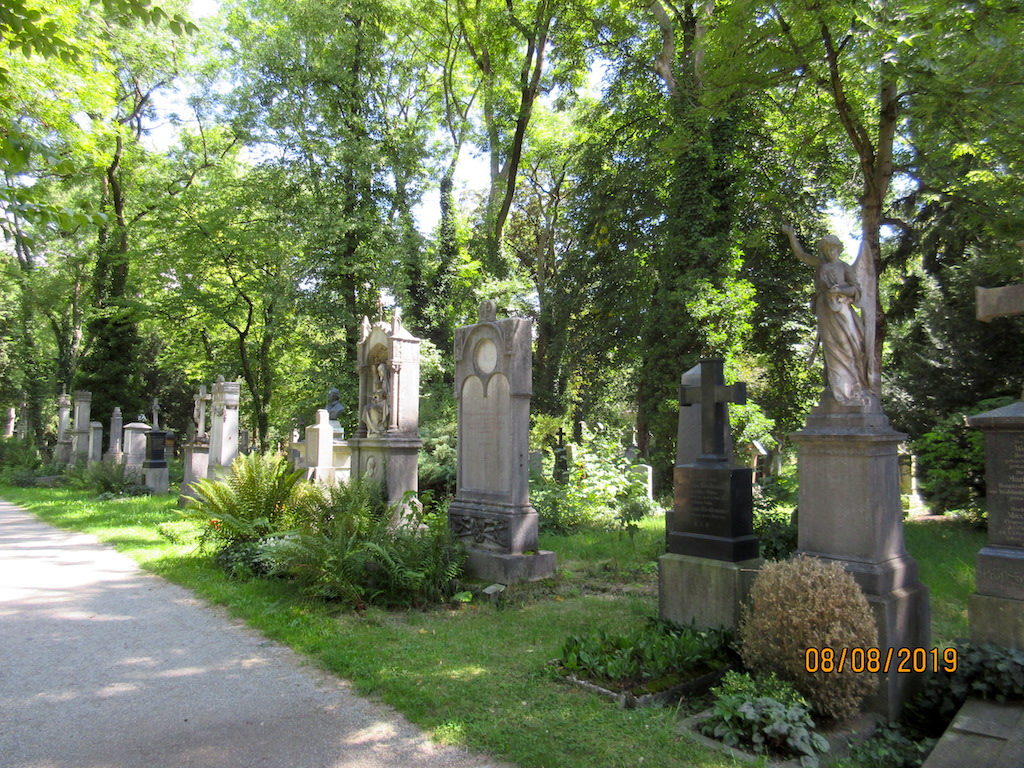
Lush Green Cemetery

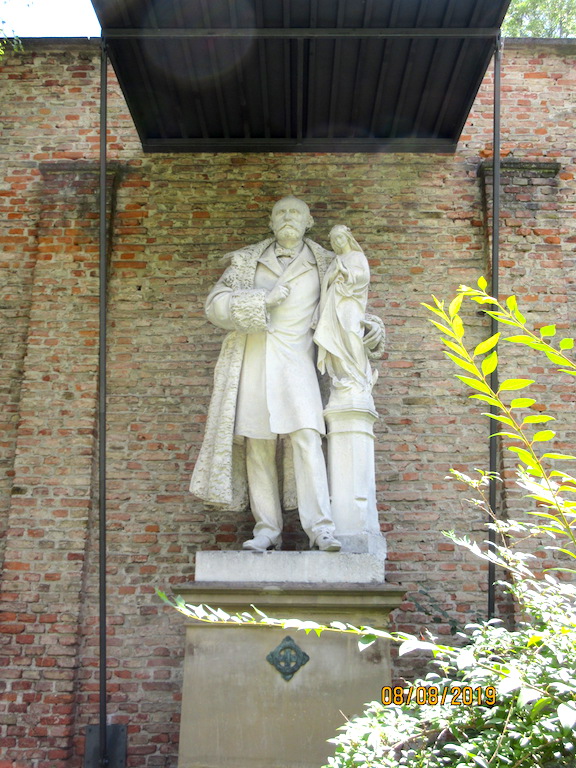
Cemetery Monument

On this day we set out on foot to an area called the Gartnerplatz, formerly the main square of the gay and lesbian scene in Munich. Today the area is one of the trendiest in Munich and is filled with many cafes, bars, hair salons, clothing boutiques and small unique shops. You don’t see any name brand stores that you see around the world in this neighborhood. There was not a lot of evidence of a gay community here….perhaps we were too late.

At a local café on the main circular plaza we had coffees and a croissant filled with what they call nougat, a creamed filling with hazelnut flavor. For lunch we stopped at a local pasta restaurant for spaghetti carbonara and a mixed green salad with tuna. It was all very good.

Nearby we toured the Alter Sudlicher Friedhof or Old South Cemetery founded by Duke Albrecht V as a plague cemetery in 1563. It was also the burial ground of the dead from the Bavarian uprising of 1705-6 which was a national people’s revolt against the occupation of the Austrian Habsburgs during the War of Spanish Succession (1701-1714). The revolt lasted 75 days with the number of deaths on the Bavarian side numbering over 5,000 men. This led to the collapse of the uprising against Austria in January of 1706 when peace negotiations led to the surrender of the Bavarians.

From 1788 to 1868 this was the only cemetery for the entire metropolitan area of Munich and why it contains the graves of many prominent Munich figures of that period. Painters, philosophers, mayors, sculptors, actors, composers, architects and more have a place here.

Today the cemetery serves as an Art and Cultural history monument and is open to the public. From 2004 to 2007 most of the monuments were renovated and cleaned but today the cemetery is quite overgrown and in need of maintenance.

The weather has been a mixed bag but today was the warmest we have experienced thus far. It was clearer and sunnier and the temperature rose to about 90 degrees Fahrenheit.

For dinner we walked next door to the Le Meridien Hotel where they have a local German restaurant. Since we had a late lunch we were not that hungry so Mark had a salad and Kent had the local delicacy: Apple Strudel with ice cream and vanilla sauce.

August 8, 2019 Munich, Germany

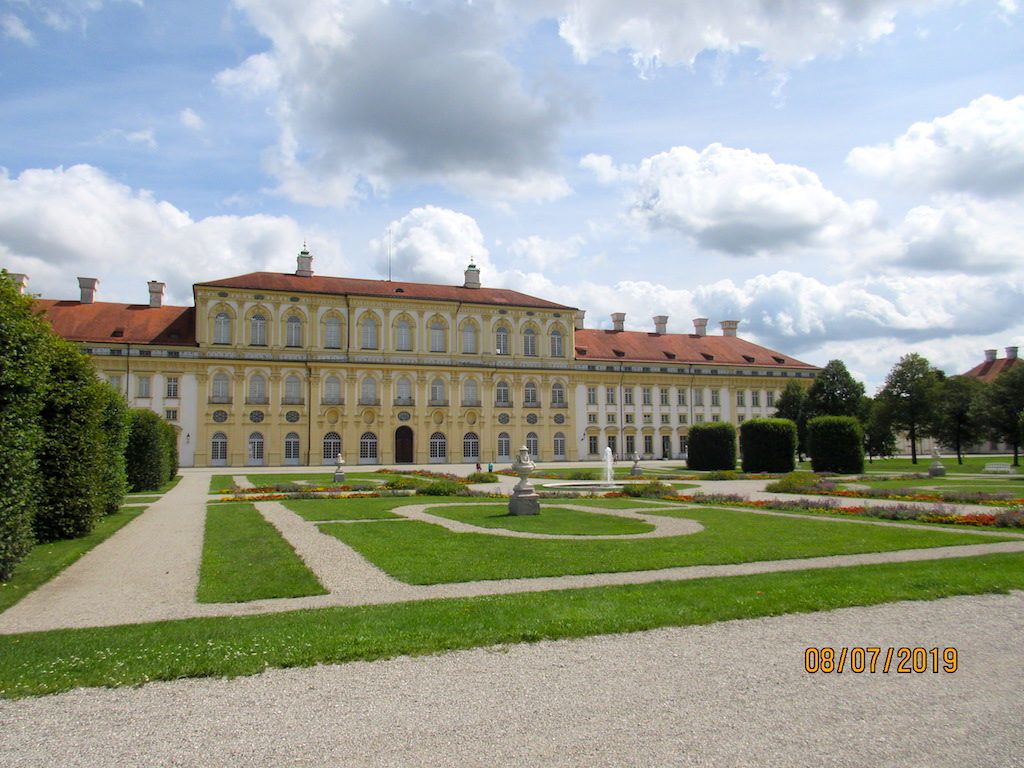
Front of the New Palace
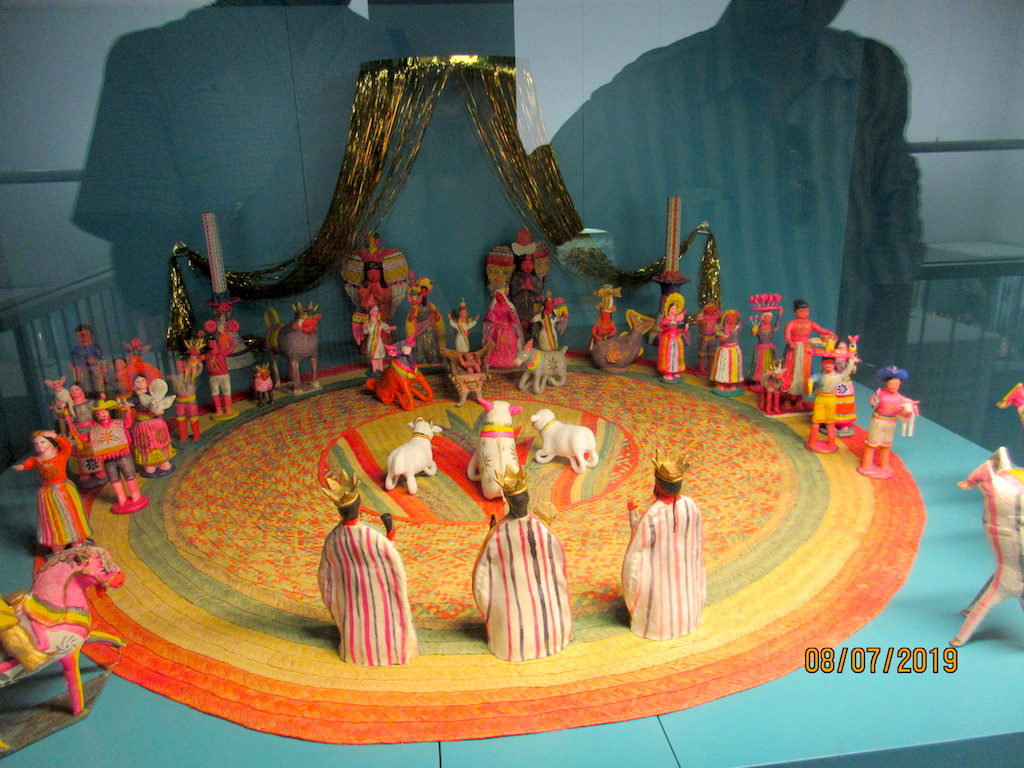
Nativity Scene
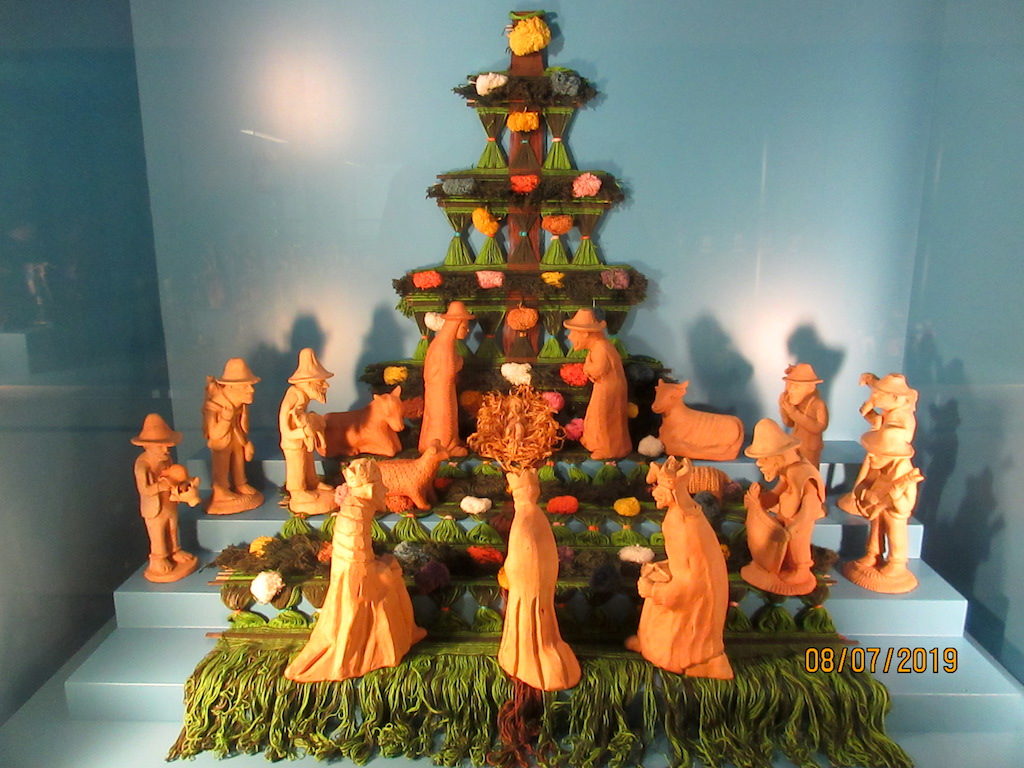
Nativity Set
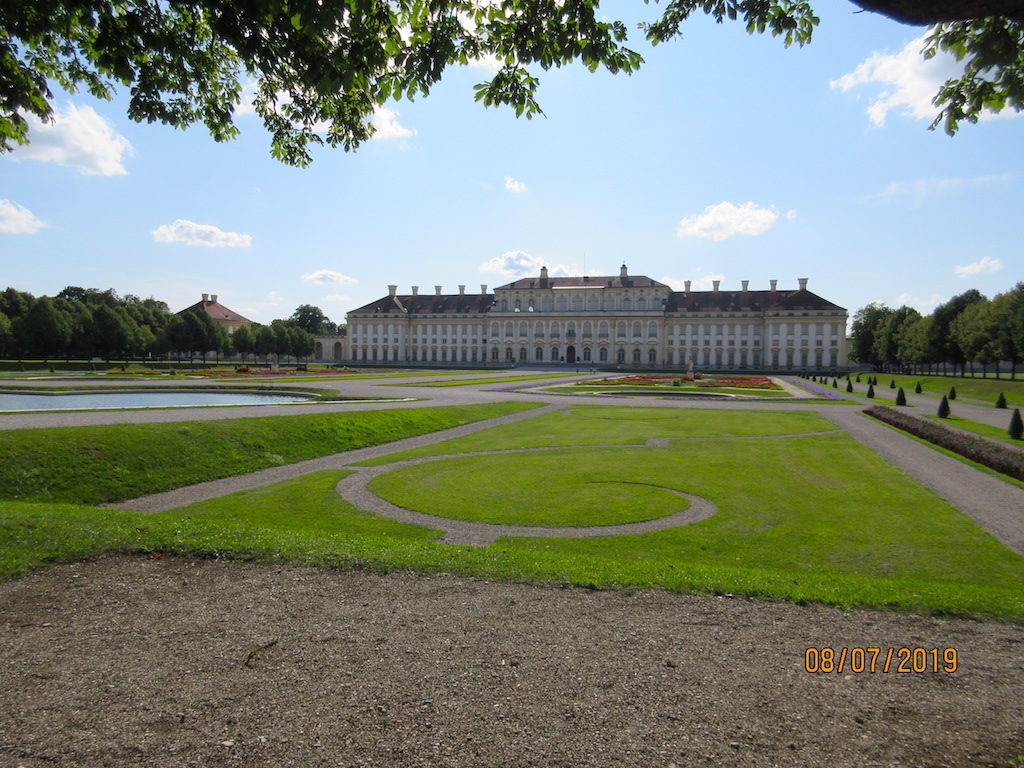
Rear of New Palace
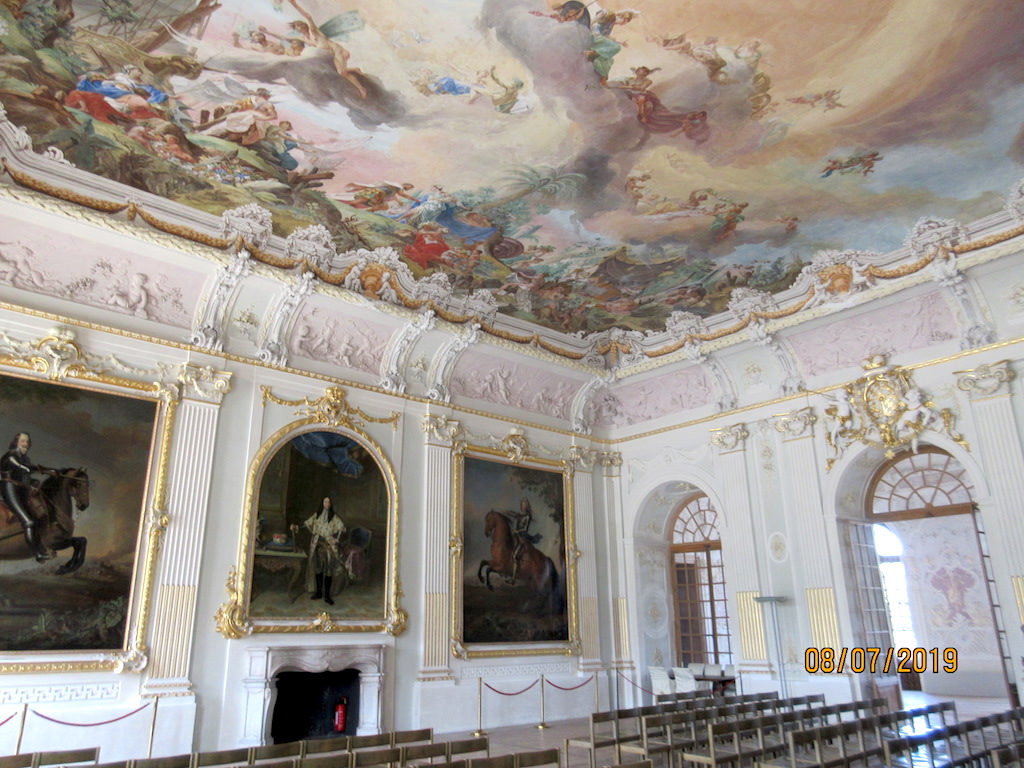
Interior of the New Palace
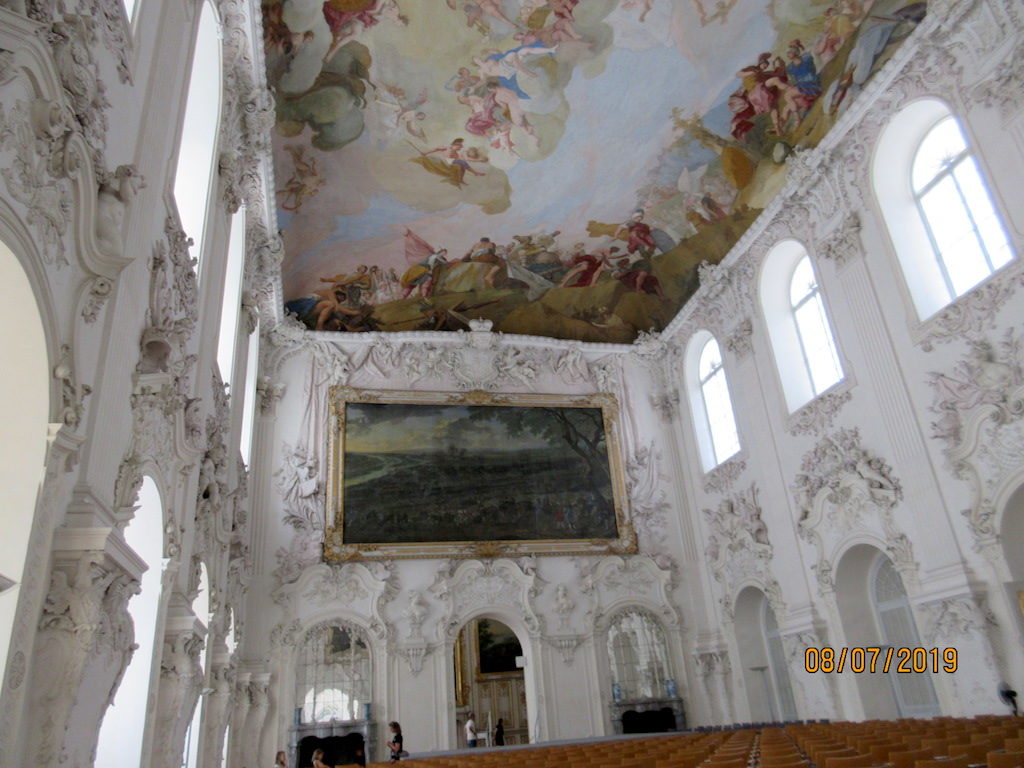
Interior of New Palace
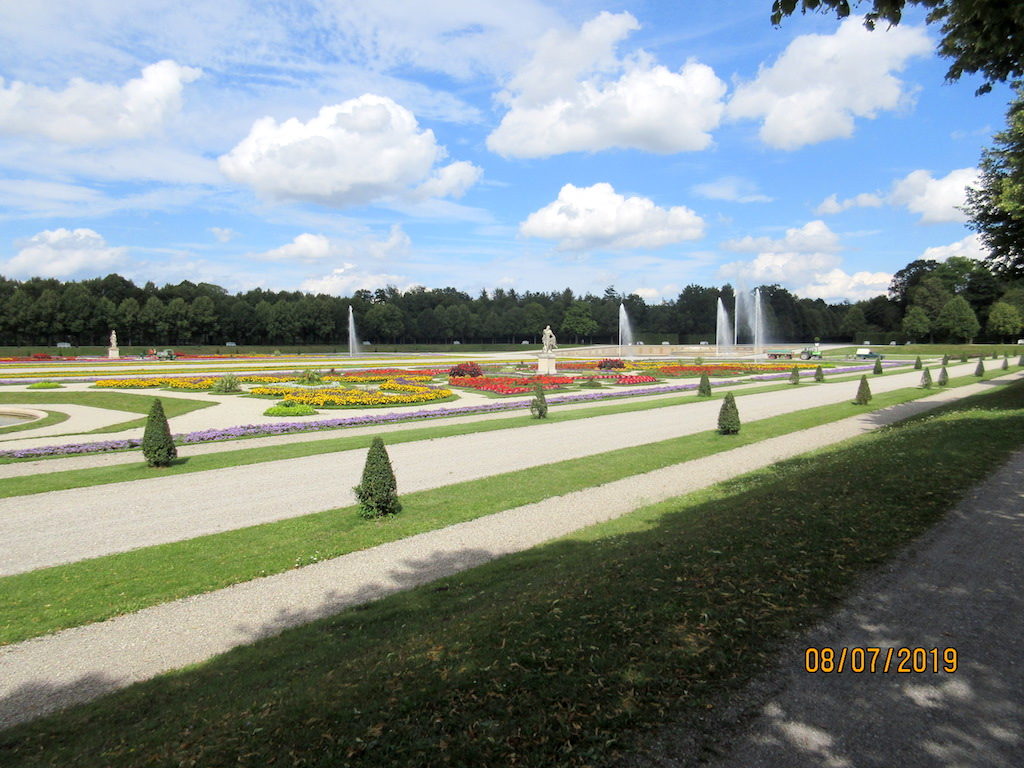
Gardens behind the New Palace

This morning we headed out by train to the Schleissheim Palace Complex built by Duke Wilhelm V of Bavaria. In 1597 Wilhelm purchased the isolated moorland farm of Schleissheim with its St. Margaret’s Chapel for a large sum of money from the Freising Cathedral Chapter. Wilhelm renounced the splendors of court life at an early stage, devoting himself to religious meditation and in 1598 finally abdicated in favor of his energetic son Maximilian.

Between 1598 and 1600 Wilhelm had an estate and a manor built within the complex, which was surrounded by small hermitages and forest chapels. The duke, who had no intention of altering the character of the property as a farm, extended its activities with a stud farm which supplied his stables. Schleissheim beer and cheese were also produced.

Attracted by the profits from the farming business, Maximilian I (reigned from 1598-1651) acquired the complex from his father in 1616 in return for a life annuity. From 1617 Duke Maximilian had his father’s manor replaced by a palace now known as the Old Palace. Most of it was destroyed during WWII, but in its reconstructed form is still the best example of a country palace in the style of villa architecture.

A new chapter commenced with the reign of Elector Max Emanuel from 1680 to 1726. Under his rule, a magnificent New Palace was built after 1700 and is one of the best examples of European residential palaces. The ceiling frescoes marked the beginning of a new epoch in South German ceiling painting, and the interiors, especially the carved paneling, the furniture and stucco-work decorations are some of the most magnificent of their kind.

The surrounding palace gardens, initially influenced by Dutch garden design, were subsequently extended in the French baroque style. Pools with cascades, fountains and formal planted beds created a unique design whose basic features have remained unchanged.

Inside the Old Palace we explored exhibitions by the National Museum showing many different Nativity scenes from around the world. The nativity sets were extraordinary from all over the world and ranged from simple sets of a few figures to extensive sets with hundreds of figures. In addition to the full nativity sets, there was an entire section dedicated to just figures of Jesus as a baby. Many were displayed in glass cases lying in beds of straw, cotton or some other material. Also, of interest was a collection of figurines of Adam and Eve depicted in all colors, shapes and sizes. There were also exhibits about religious Christmas decorations, hand-painted eggs and icons from Russia.

In the New Palace we toured about 40 rooms filled with original plaster details, frescoed ceilings, brocade upholstered walls, hardwood floors and extensive art from the period provided by the National Museum. The excellent condition of the palace and the sheer size of the property is mind boggling.

At the far end of the garden there is a two-story building, originally built as a hunting lodge between 1684 and 1688, that now houses an incredible collection of 18th-century Meissen Porcelain. The porcelain collection has not only dining place settings but also tea pots, serving pieces, animal figurines, candlesticks, vases and more. The collection was very interesting. Kent wanted to sit down in this building and proceeded to fall off a padded stool into one of the porcelain display cabinets. Five guards came running and appeared to be more concerned about Kent than the porcelain. No porcelain was broken and Kent is OK, too!

Also, on the property is a small chapel and stable building. The gardens are very beautiful and extensive. It was a wonderful day spent in the countryside and there were very few people visiting the palaces so it was a joy to take time and enjoy each magnificent detail.

Back in Munich we walked to a local Vietnamese restaurant near our hotel for dinner. We were tired but it was a good day.

Some Munich observations: Lots of people, especially women, smoke on the street. Many people are seen eating sandwiches out of paper bags while walking along the street. Many food stands have no place to sit, so purchasers eat on the street while going from point A to B. There are many non-Germans from a wide variety of countries on the streets. Sometimes it is difficult to find people on the street who look “stereotypically German.” They are there, but are seemingly outnumbered in central Munich.
August 7, 2019 Munich, Germany

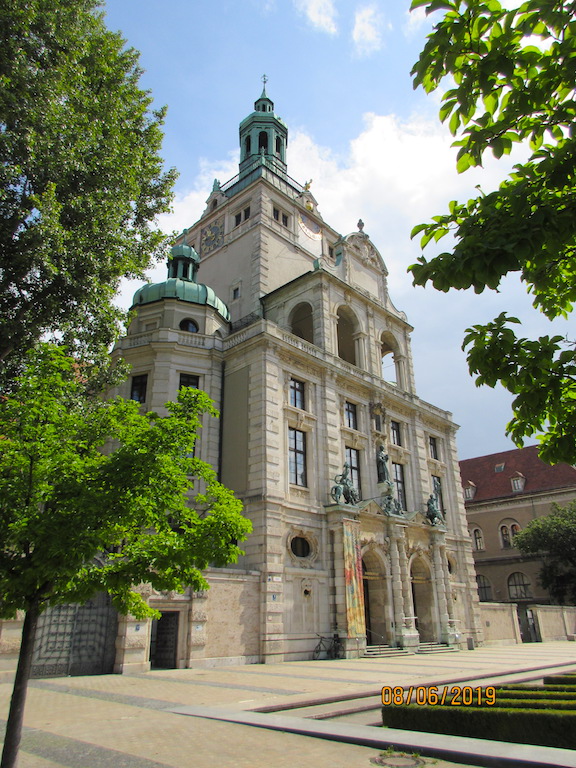
Facade of the National Museum

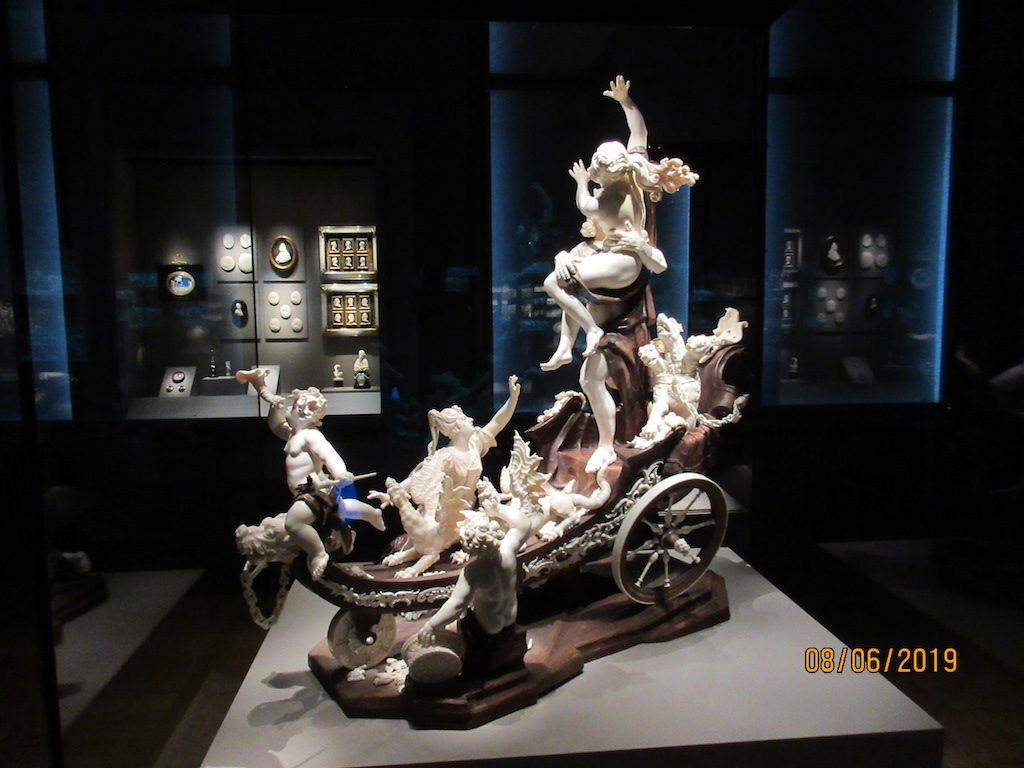
Wood and Ivory Carving

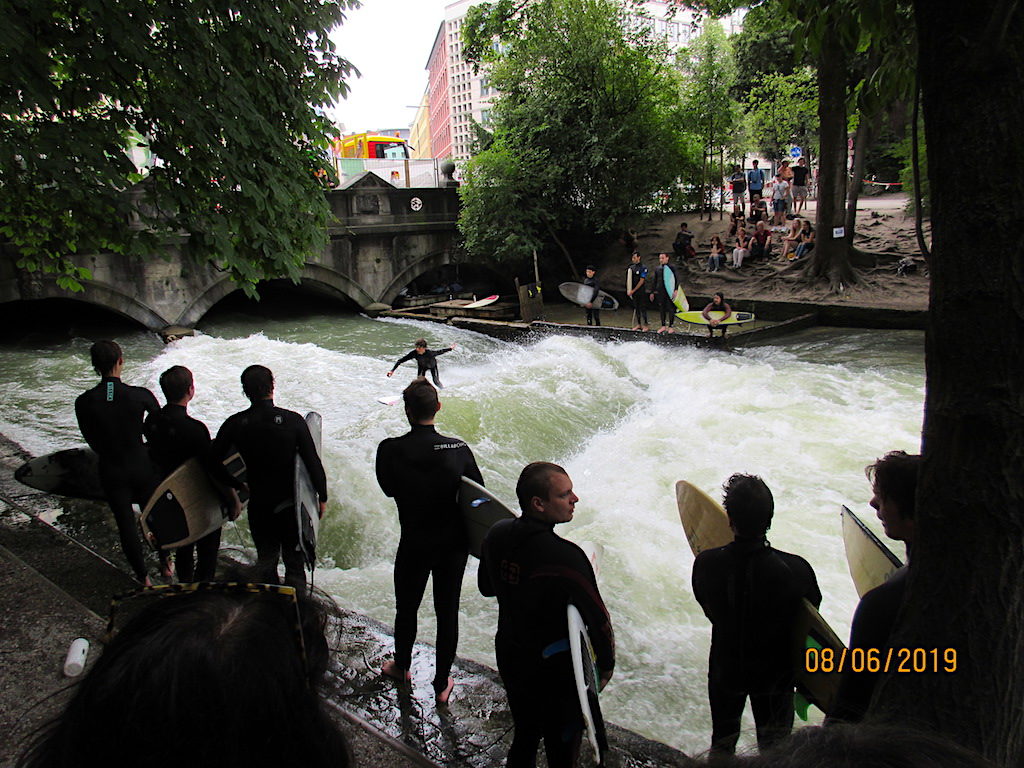
Surfing at the English Garden

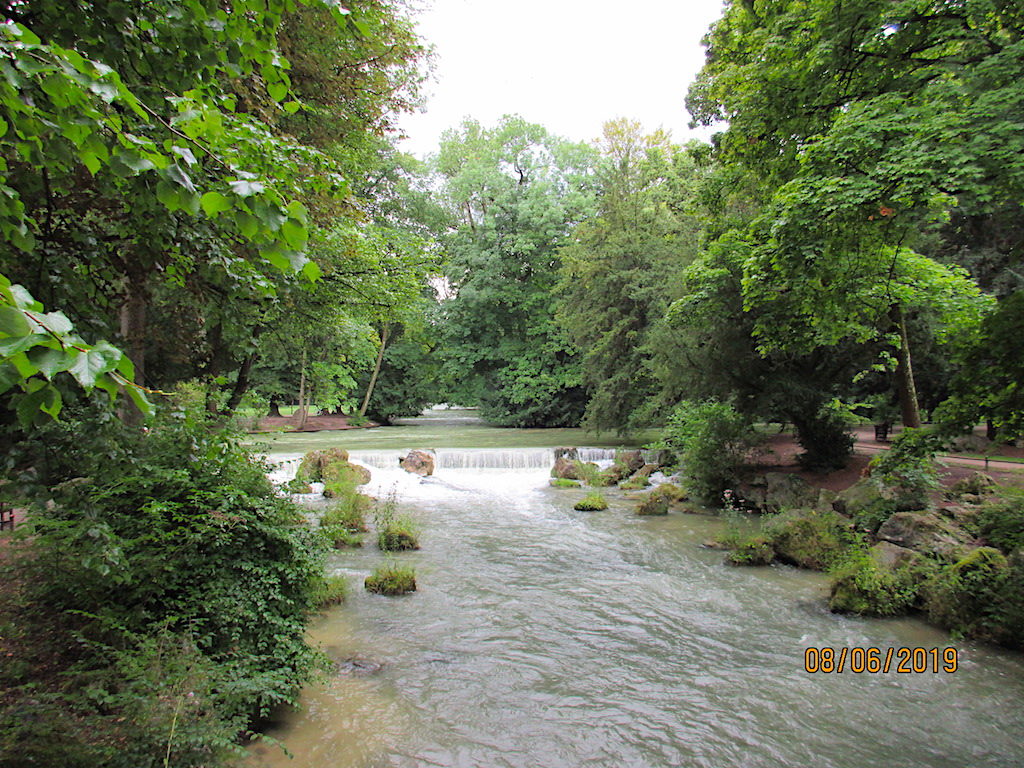
View inside the English Garden

Marc Fritz at Dinner with us.

This morning we had coffee and a cinnamon roll at the train station before boarding the Hop-On, Hop-Off for a ride to the Bayerisches National Museum. The museum has a collection of about 500,000 items of all types. We toured three floors of the museum where we saw collections of china, glassware, silver, inlaid furniture, statuary, altarpieces, armor, stained glass windows, religious wood carvings and more. They have the largest collection of nativity scenes at the museum but unfortunately the collection is only open from November to April.

After several hours in the museum we headed next door to the massive English Garden started in 1789 by Elector Carl Theodor who ordered a public park be established along the Isar River. Today the park consists of over 900 acres and 48 miles of paths for biking and walking, has beautiful vistas of the city, includes a restaurant, beer garden and Japanese Tea House.

We had lunch at the beer garden including a pork schnitzel, roasted potatoes, potato salad, and sodas. While we were having lunch, a thunderstorm came through causing people to find shelter under large umbrellas and a Chinese Pagoda in the park.

While at the park we also took in an unusual sight of young men surfing. There is a river lock that creates a large wave when the water flows over the lock creating an ideal spot for surfing. Unfortunately, the size of the lock is small and only allows enough room for one surfer at a time. The good news is that there is a constant wave for surfing.

The walk back from the garden is about thirty minutes. Along the walk we took in part of Maximillian Street where all of the high-end retailers have their shops. You find Gucci, Prada, Louis Vuitton and so many more.

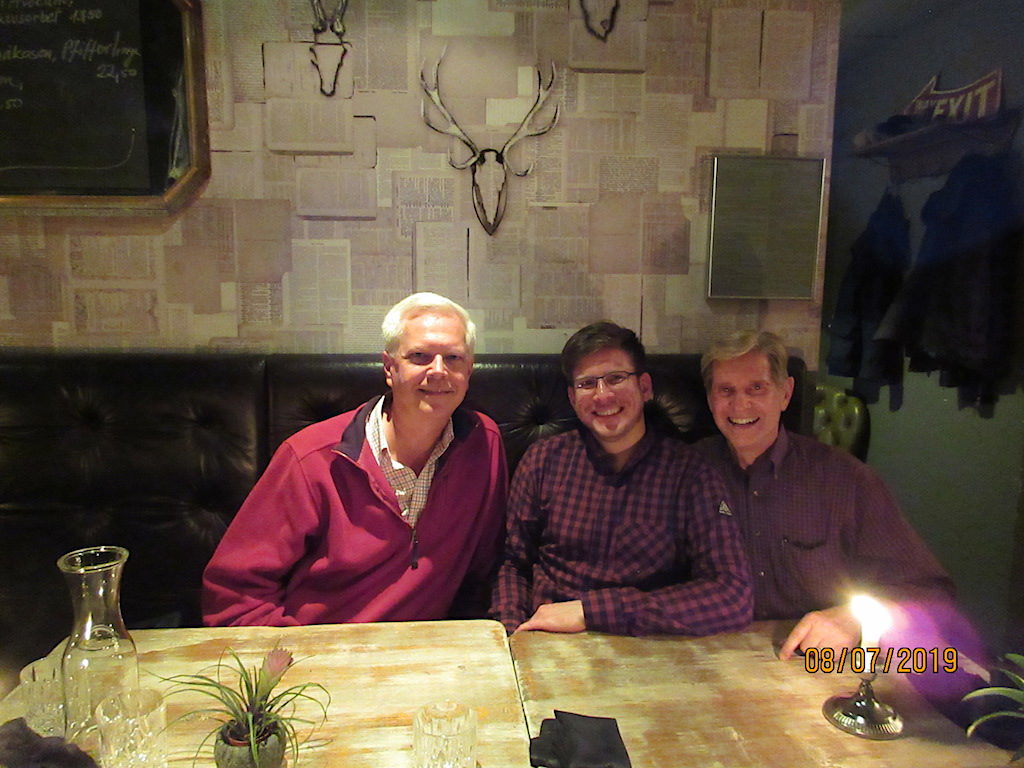
In the evening we met up with one of our former German students, named Marc Fritz, who is currently working in Munich although he is originally from Dusseldorf. We last saw him in Amsterdam in 2016 before we boarded a ship in Rotterdam. We took the subway one stop to a completely different looking part of Munich for dinner. As soon as we stepped out of the subway station it was quiet, the streets were tree lined and were spotless. We had a very nice dinner at a charming restaurant with candle lit wooden tables called Hoiz Weinbistro. They served things like duck breast with quinoa, a variety of steaks, salads and steak tartar.

August 6, 2019 Munich, Germany

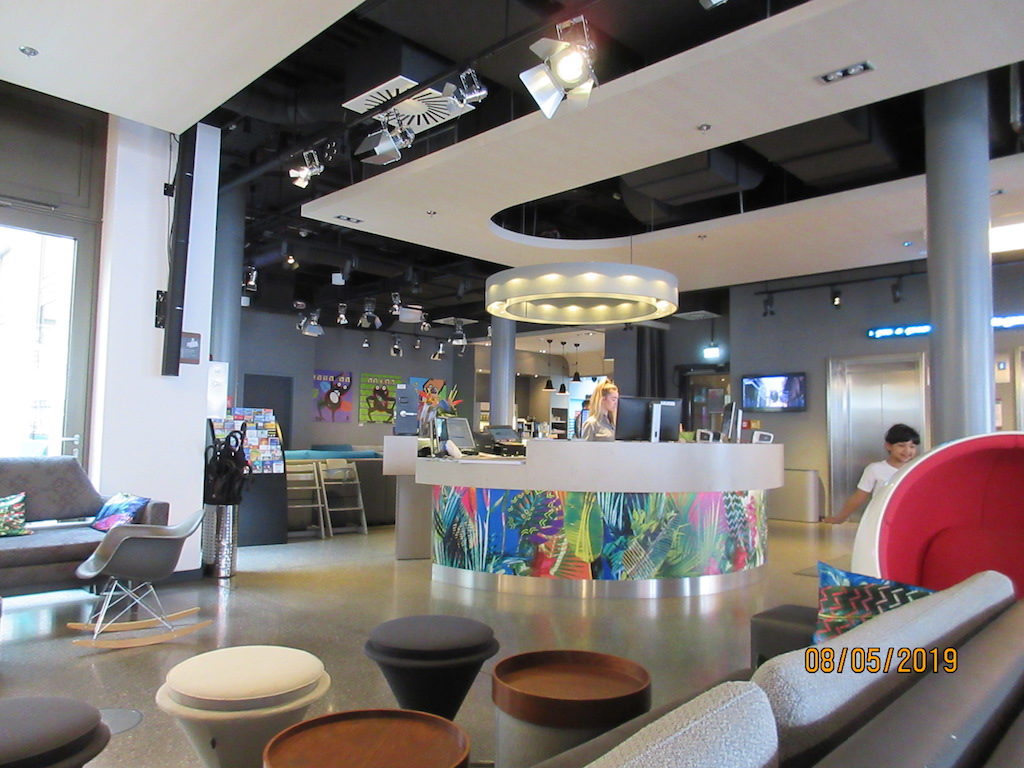
Aloft Hotel Lobby

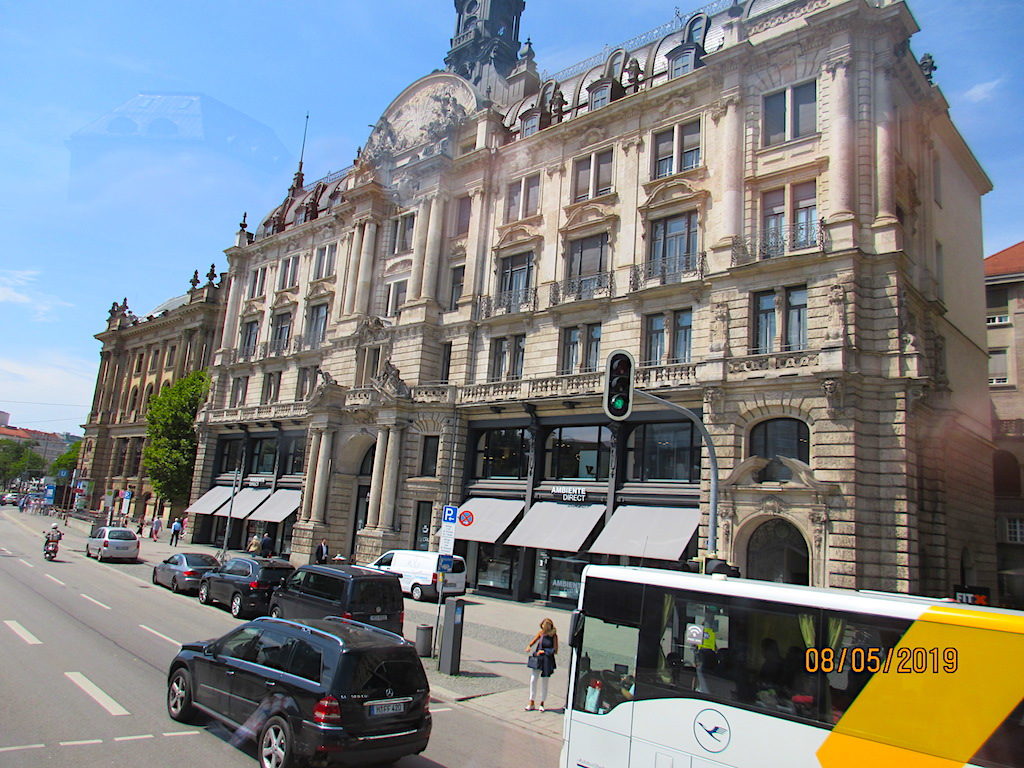
Munich Architecture

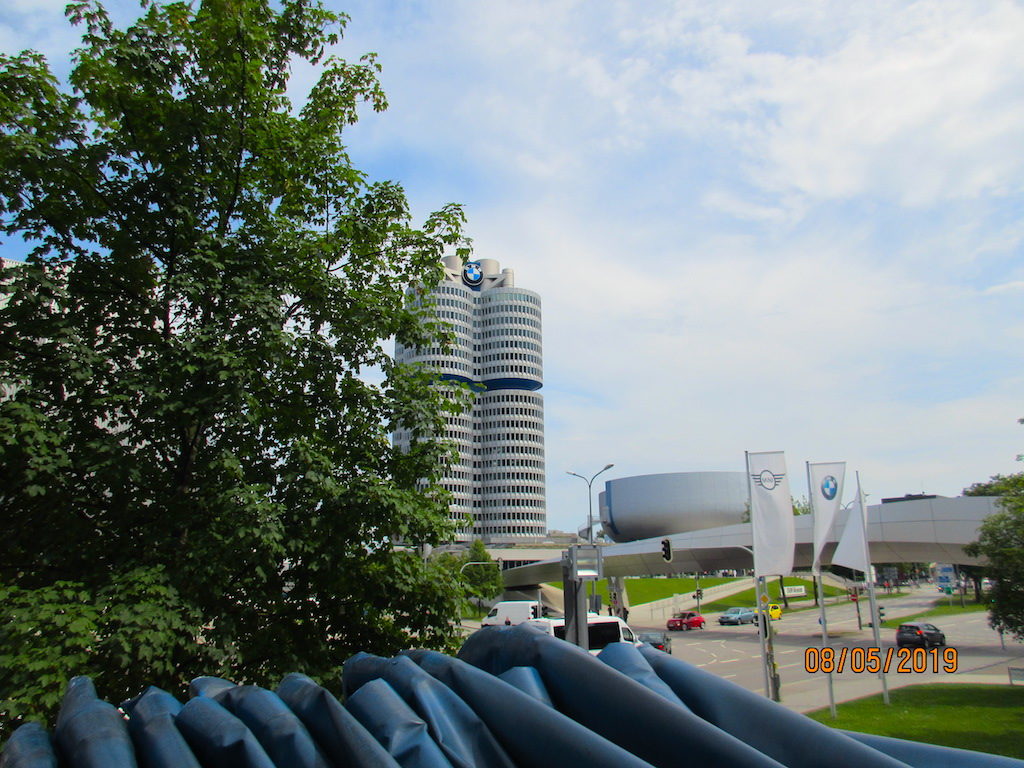
BMW Museum

Statuary

Architecture

We had a quiet day as we recouped from our long journey. We had a lazy morning in the hotel before venturing out for lunch to a local Italian restaurant called L’Osteria. There we enjoyed a fresh salad with mixed greens, avocado, pomegranate seeds, sunflower seeds and quinoa. The dressing was called a creamy dressing and it was very good. The pizza was a four cheeses pizza that was the size of an extra-large pizza at home. Luckily the girl at the hotel had warned us that the portions were large. The crust was very thin and crispy but otherwise the pizza was not very interesting.

Next, we boarded the local Hop-On, Hop-Off bus operated by Greylines tours. The bus took us on a 2.5-hour tour around the city giving us some bits of history and pointing out architecturally significant buildings. The tour included places like the Olympic Park where the Summer Olympics were held in 1972. As you may recall these were the Olympic Games where terrorists broke into the athlete’s village and took Israeli athletes’ captive and eventually killing them. Today the grounds are used mostly for public events, concerts, fairs and there is a Sea Life Aquarium on the grounds.

Across from the Olympic village is the BMW headquarters and Museum. The museum shows BMW’s technical development throughout the company’s history. It contains engines and turbines, aircraft, motorcycles, and vehicles in a plethora of possible variations. In addition to actual models there are futuristic-looking, even conceptual studies from the past 20 years. The museum is one of the most visited in Munich with more than 250,000 visitors a year.

The city has a large museum district with a variety of museums, there is the large city park called the English Garden, an opera house, cathedrals, high-end shopping streets and a variety of historical monuments.

After a refreshment in the hotel lobby and a nap we ventured out to the main train station for a small bite to eat at a Chinese Restaurant. The train station was a little quieter in the evening but still a busy place with folks coming and going in every direction.

August 4-5, 2019 San Diego, California to Munich, Germany

Our flight left San Diego at 2:50pm bound for Frankfurt, Germany arriving the following day at 11:05am. The flight was about 11 hours in duration. Our flight departed Frankfurt at 12:15pm arriving in Munich at 1:10pm. This was a very short flight of less than one hour. Once we arrived in Munich we had to find the S Bahn train station where we boarded a local train for the 45-minute ride into central Munich train station called the Hauptbahnhof.

Our hotel for the next six nights is a Marriott brand hotel called the Aloft Hotel. The hotel is just adjacent to the main train station so we only had a short walk with suitcases to our hotel. The hotel is a smoking free hotel which is a good thing in Europe since so many people here smoke. The hotel has a very casual lobby with a traditional bar, comfortable tables and chairs to sit at and comfortable sofas and chairs to relax in. There is a coffee and snack bar with fruit, snacks, coffee and tea all for sale.

After a short nap we ventured out on foot to the main square called the Marienplatz about a fifteen-minute walk from our hotel. The streets are extremely busy with people of all colors and ethnicities, dining at sidewalk cafes, shopping and coming and going in every direction.

Munich is the capital city of Germany and has a population of about 1.5 million inhabitants in the city and 2.75-million in the urban area. It is the fastest growing and most prosperous of all cities in the country. The city is now home to about 45,000 Turks, 30,000 Albanians, 25,000 Croatians, 25,000 Serbians, 25,000 Greeks, 20,0000 Austrians and 25,000 Italians.

For dinner we stopped at a local German restaurant next door to our hotel where we had sausages and sauerkraut, chicken schnitzel and potato salad. The potato salad is mixed with chopped cucumbers for a bit of crunch and is a bit vinegary than we might be used to. As is typical in most of Europe, table water is not served with your meal. Instead you are expected to pay for either bottled water or, as was the case today, we could get a small glass of tap water for 1 euro 20.

We were very tired from our long trip and retired about 9:00pm.

June 25, 2019 Return Home

Our flight home departed about 10:00am bound for Newark, New Jersey arriving about 12:30pm local time. When we arrived in Newark we learned that our flight to San Diego had been delayed due to high winds and bad weather in the area. We ended up spending about seven hours in the airport before our flight for San Diego took off. The flight home was another six hours in the air and we arrived home about 11:00pm, exhausted but glad to be home.

June 24, 2019 Prague, Czech Republic

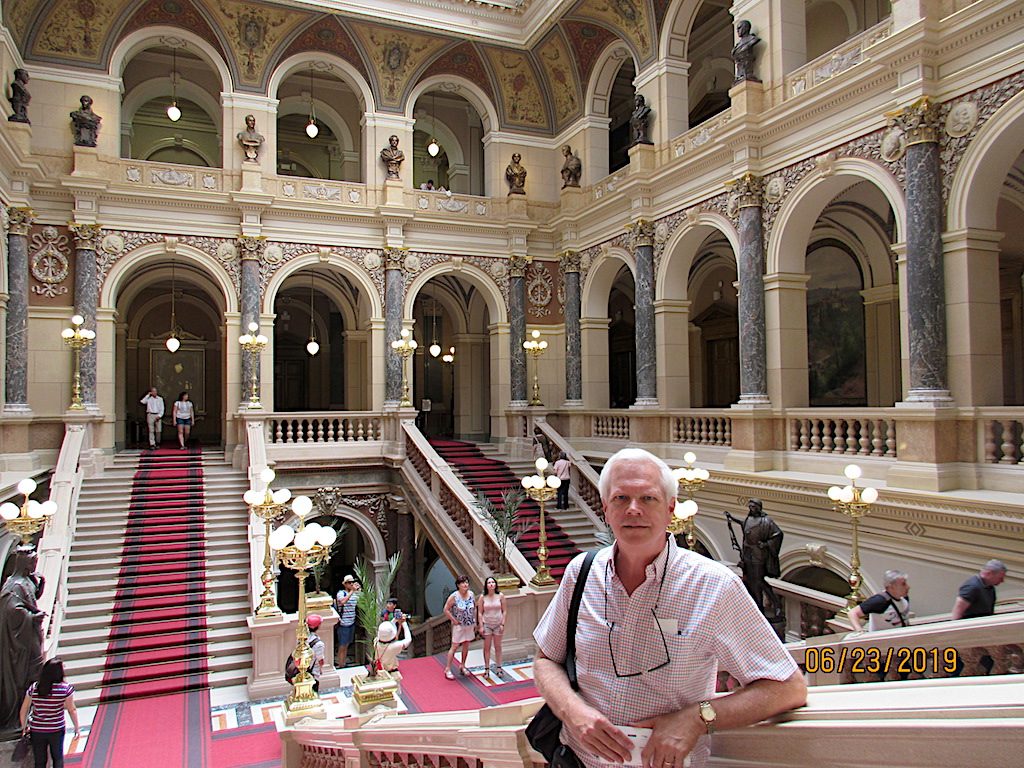
Prague National Museum

Prague National Museum Interior

Prague National Museum Interior Courtyard

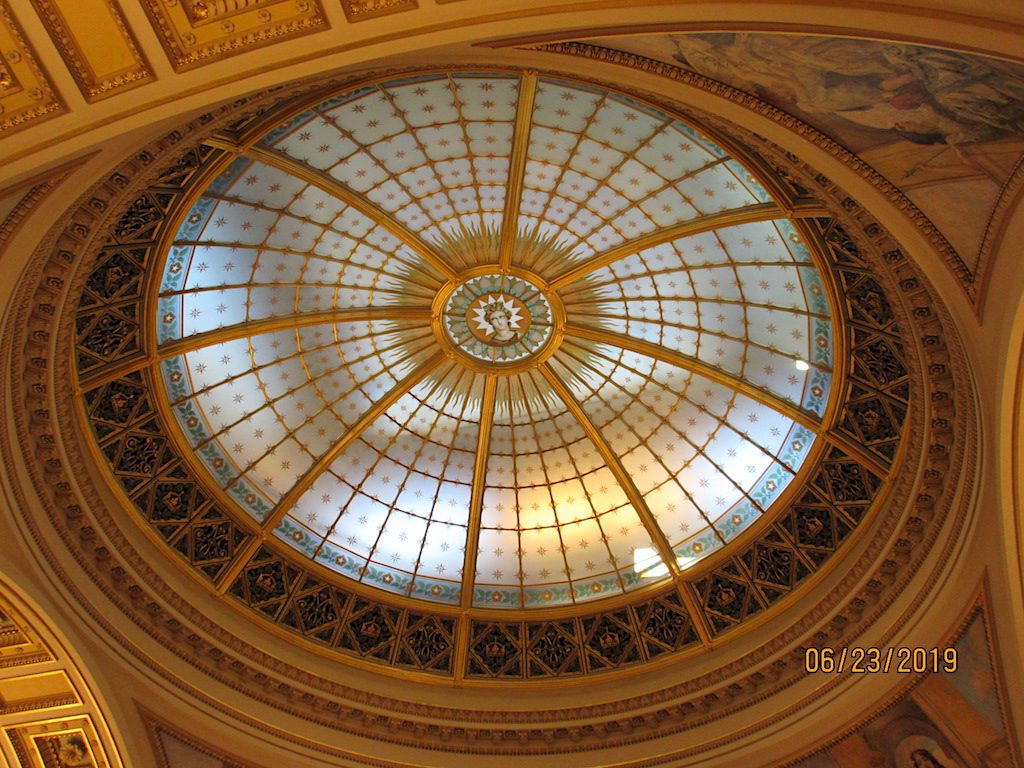
Prague National Museum Dome

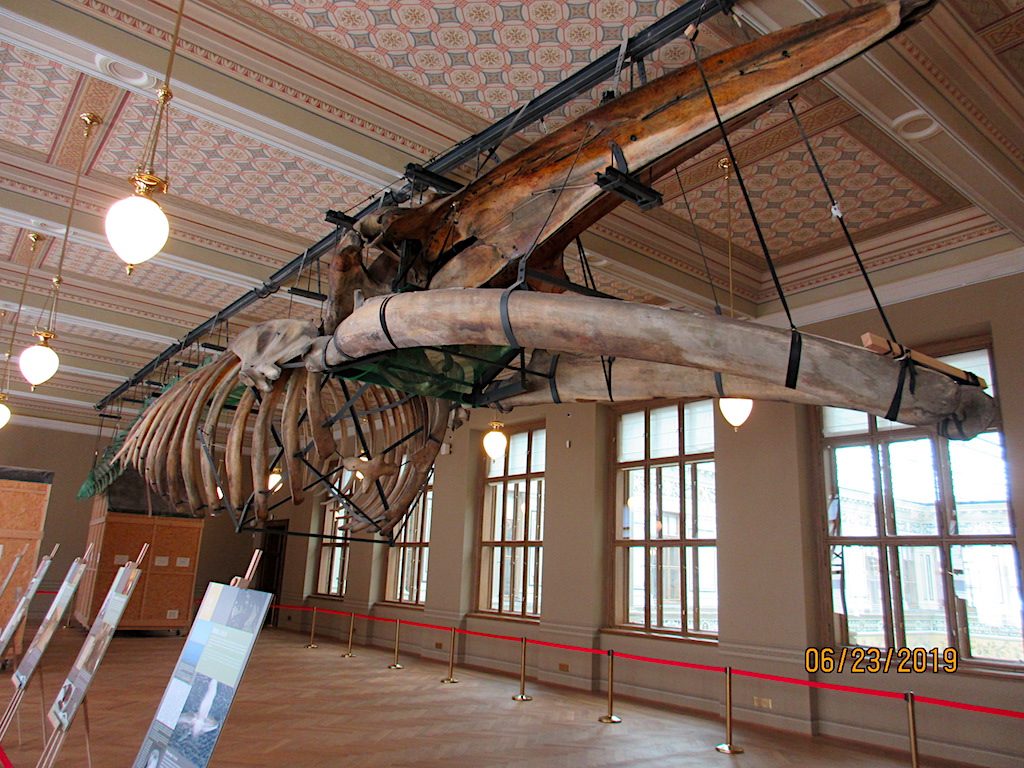
Prague National Museum Whale Skeleton

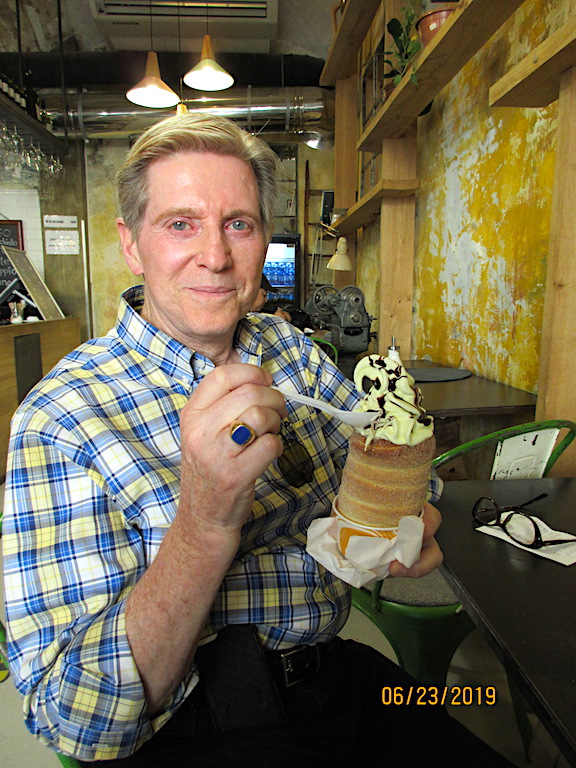
Kent trying the local dessert treat.

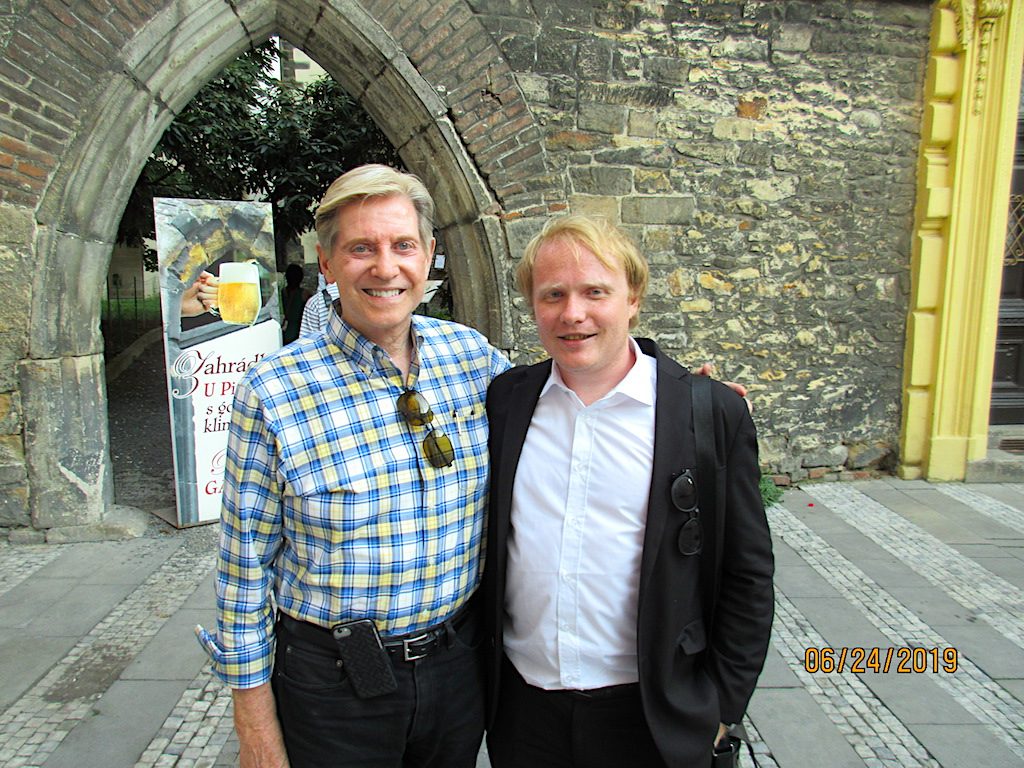
Kent and Michal

Today was a free day to explore the city of Prague further on our own. We started out the day looking for a new suitcase for Mark to replace the one that was damaged by the airlines. We did find one across town at a large shopping mall but then had to drag it back across town on the cobblestone streets and sidewalks.

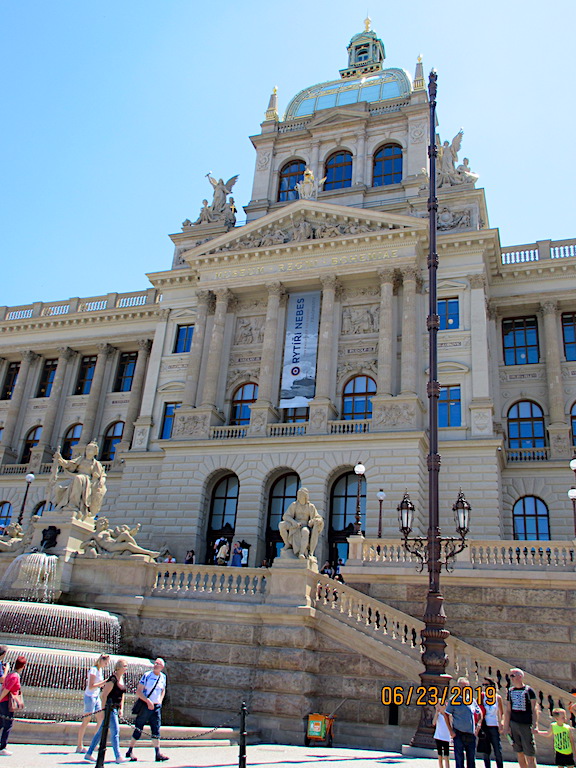
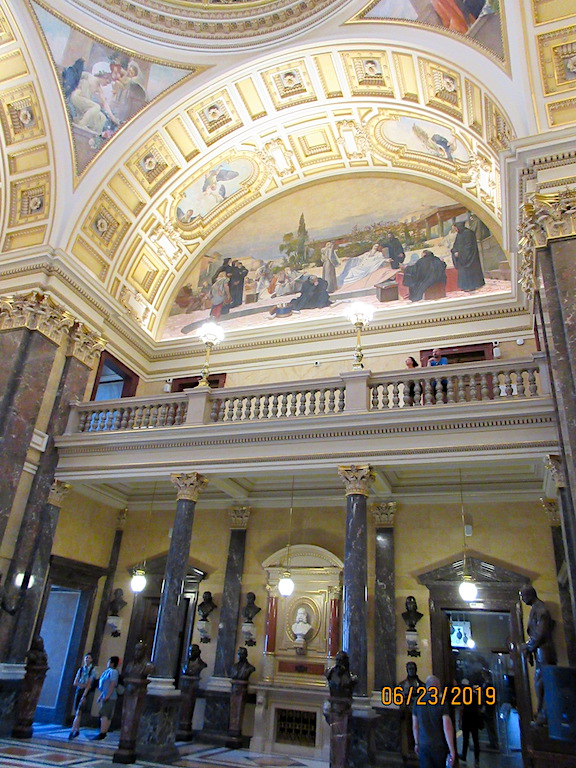
After a short rest at the hotel we headed to the National Museum which was just partially reopened on October 28, 2018, after being closed for seven years for extensive restoration. The museum has been located in this location since 1891 so I am certain it was due for a facelift. The Neo-Renaissance building has been beautifully upgraded and restored although not all of the exhibits will be open for another year or so. The entire collection of the museum consists of over 20 million items so only a fraction of the collection can be on display at any given time.

The first exhibit we saw was called “Knights of the Heaven.” About eighty years ago, in 1939, many Czechoslovak pilots left for Great Britain, where they joined the newly created Czechoslovak Squadron of the Royal Air Force. The exhibit tells their stories and includes photographs, a film, uniforms and biographical information on many of the people who served. It was interesting to see that many women also served even though they were not pilots but had many support jobs.

The next exhibit that was open was about the Czech-Slovaks/Slovak-Czechs. This year marks a century from the foundation of Czechoslovakia, a state formed by two different parts of the Habsburg Empire. They shared a joint cultural history of great diversity. The exhibit includes a wide variety of information about the successes and failures the state went through during its existence. The exhibit included information about the education system, religion, media, the documents that created the joint state, the items manufactured in the country during that time, as well as everyday items that people might remember from that time.

The museum has had a full skeleton of a whale on display since the museum opened and it is now back on display in a newly renovated space. Since the skeleton was too fragile to move during the renovation it was decided to surround it with a protective structure and to leave it in place. The room has been transformed and soon the skeleton will be cleaned and restored as well for its next century of visitors.

The final exhibit currently on display is an anniversary celebration of two centuries since the museum has been in existence. Here they have pulled together about 200 of the most interesting pieces out of the 20 million in the collection. This means that the items on display were a mismatch of all sorts of items but each very interesting in its own way. There were priceless jewelry pieces to taxidermy animals and an 1818 stamp, along with the wedding dress of Marie Louise, Duchess of Prague in 1810.

For a little break from the museum we ventured down the street for Kent to find the local tourist treat called the Trdelnik or Chimney Cake. Originally from the Hungarian speaking part of Transylvania in today’s Romania, this dessert has penetrated to many other places. The name refers to the wooden tool that the dessert is made on. It is a cone shaped wooden rolling pin of sorts that a bread dough is wrapped around creating a cone or chimney shaped bread ring. The wooden pin is then turned over an open flame to cook the bread dough until it is slightly browned and crispy. Traditionally it would have been served plain but today, for the tourists they coat it with things like chocolate and fill it with ice cream. It is mostly a tourist treat and not something the locals would fix for themselves.

After the less than delicious dessert treat we headed to another National Museum building where we saw one more exhibit. This building was once the Prague Stock Exchange, then as the Parliament building, a radio studio and then a part of the museum since 2009. On display here was an exhibit on the Celts who are believed to have lived in Europe as early as 1200 BC. The museum here has a very nice collection of archeological finds from graves including coins, tools, ornamentation and more.

In the evening we at met up with one of our former students from Czech Republic by the name of Michal Holas. Michal is now working in China but was back in Prague on this day for a conference. He has a law degree and works with Czech companies who want to do business in China by assisting with contacts, documents, etc. He is looking well and has a girlfriend of five years who is a student just finishing her studies to become a dentist.

As we have made our various stops, we have enjoyed chatting up the locals and tourists….mostly younger men. We have met guys from Spain, Sweden, Finland and a couple of Italians who play clarinet in the military band. We also encountered a young man and his family from China and a bartender from Ukraine in a restaurant we stopped in to have lunch. He is heading to the USA to visit Florida soon. We me another student from Ukraine who is studying here and selling Hop On-Hop Off bus tickets. All seemed willing to chat, share their information and inquire about us. One Italian thought Kent looked like “Ron Howard…but much older!” Enough of that.

June 23, 2019 Prague, Czech Republic

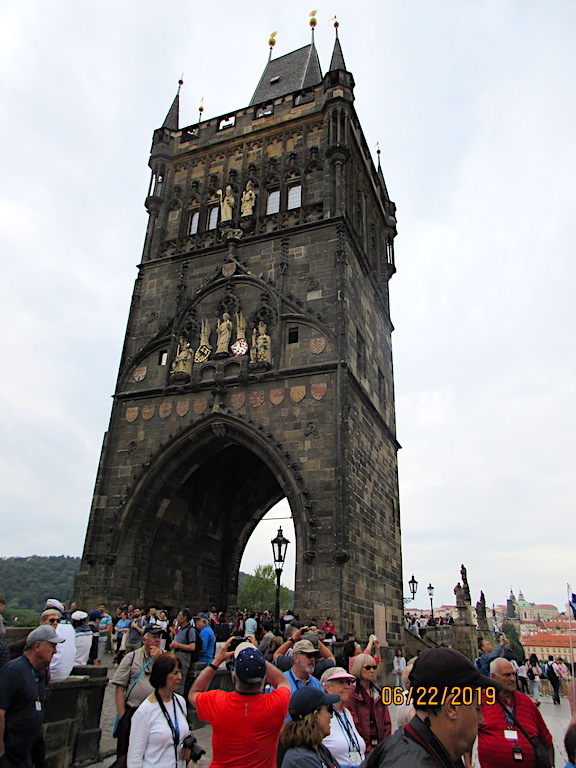
Prague-Charles Bridge Tower

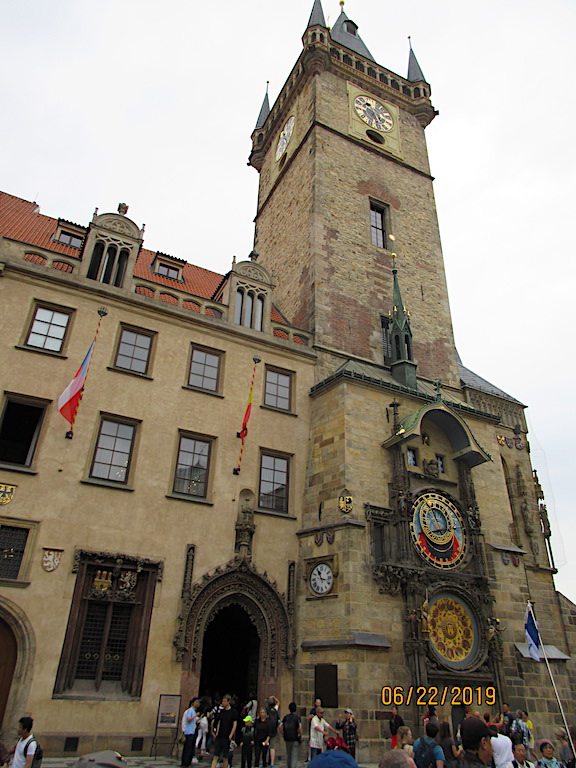
Prague-Town Hall

Prague-Astronomical Clock

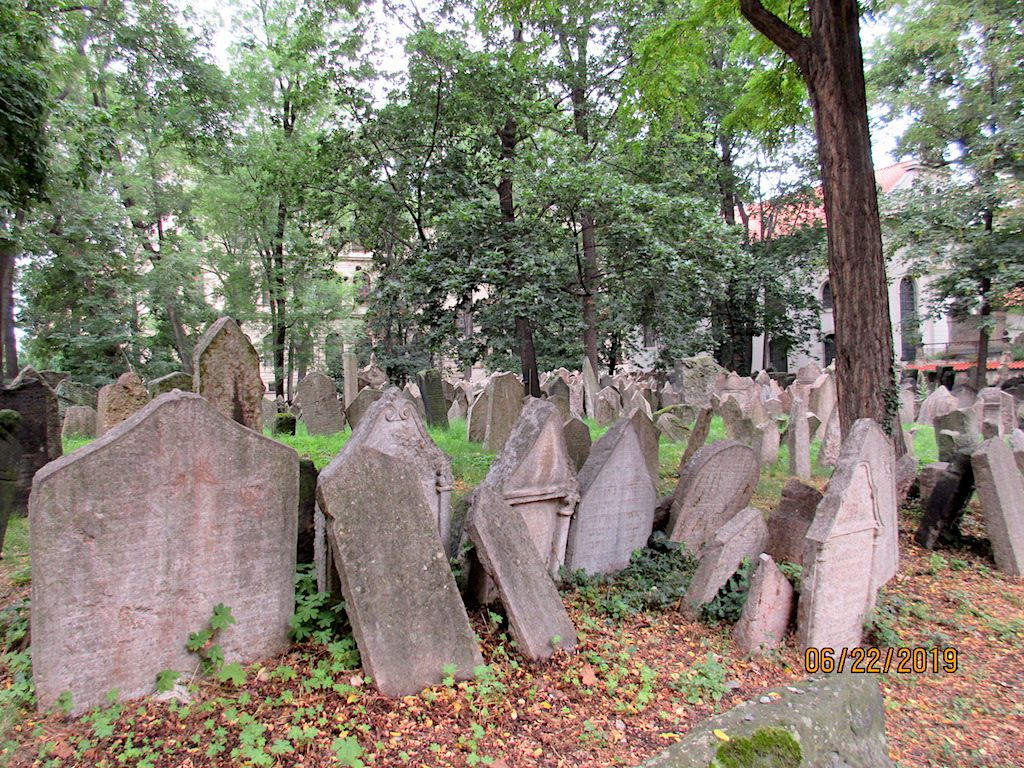
Prague-Old Jewish Cemetery

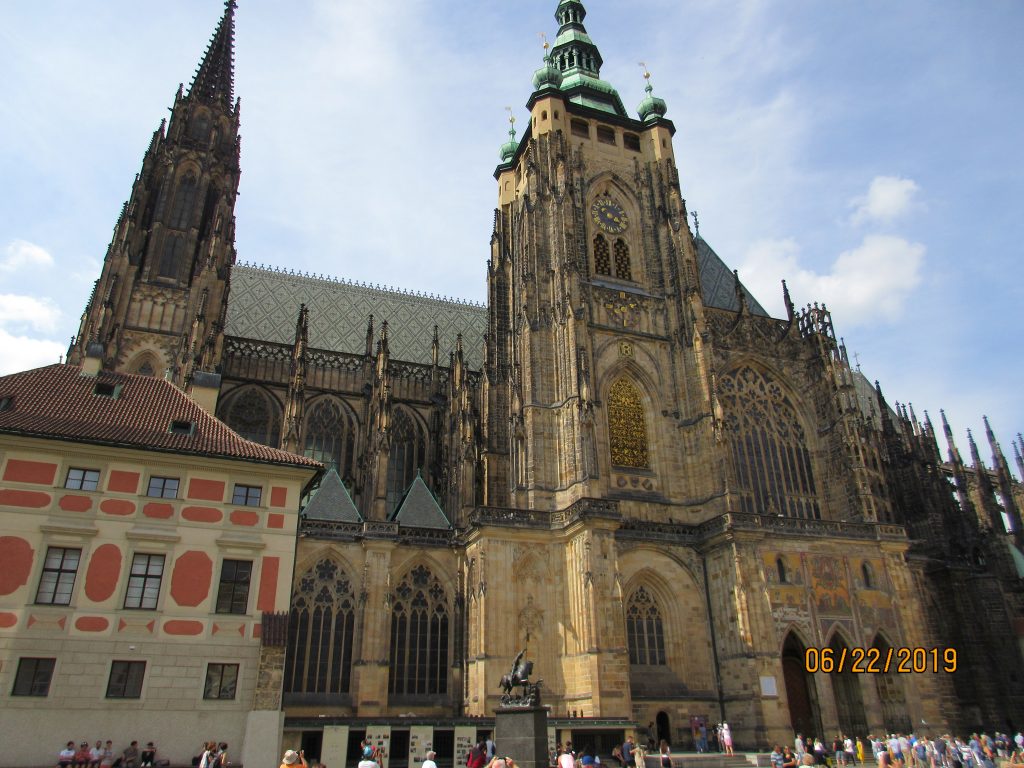
Prague Castle-St. Vitus Cathedral Exterior

Prague Castle-St. Vitus Cathedral Interior

Prague Castle-St. Vitus Cathedral Stained Glass Window

Prague-Sprawling City View from the Castle

We had a bus and walking tour of Prague this morning to orient us to the city including the famous Old Town, New Town (Think 300 years old) and the Jewish Quarter. One of the most beautiful and best-preserved cities in Central Europe, Prague is called “the Golden City” and “the City of 1,000 Spires,” both fine testaments to the abundance of gilded churches that punctuate every square. Picturesquely situated on the banks of the Vltava River, Prague has played an important part in the history of Europe, while somehow managing to avoid being overrun and destroyed as have so many of its neighbors. There is magnificent gothic, baroque, and Romanesque architecture throughout the city.

We explored the shore along the river including the ornately decorated Charles Bridge, completed at the beginning of the 15th century. On either end of the bridge stands an elaborate gatehouse and while crossing the bridge you find many baroque style statues of Saints. The 2,037-foot-long bridge was used to connect Prague Castle to the city’s Old Town. It is very popular with tourists, of which there were many!

Once we reached the Old Town Square, we stopped to admire the medieval astronomical clock located on the town hall. The clock was installed back in 1410, making it the third-oldest astronomical clock in the world and the oldest clock still operating. The clock has three main components: the astronomical dial representing the position of the sun and the moon in the sky; statues of various Catholic Saints stand on either side of the clock; “The Walk of the Apostles” where figures of the apostles are moving sculptures-notably a figure of Death striking the time; and a calendar dial with medallions representing the months.

Our next stop was at the Maisal Synagogue in the former Prague Jewish Quarter. It was originally built about 1592, although it has gone through many alterations over the years. Behind the synagogue is a Jewish Cemetery which is one of the largest of its kind in Europe. Renowned personalities of the Jewish community were buried here from the middle of the 15th century to about 1787. Due to a lack of space, new levels of soil continued to be added to the top of the existing cemetery until there were as many as twelve layers of graves in the cemetery. The gravestones were often covered over or moved up as the soil was added so that today there is a sea of headstones.

After our morning tour we were given a break to explore the town further and to have lunch on our own. We found a small local restaurant and bar where we could have a bite to eat and rest up for our afternoon tour. At the restaurant was a bachelor party (Or Stag Party) like several we had seen the night before. The groom’s friends dress up in formal wear or fancy sports coats, while they dress the groom in drag for the festivities. This group of men were dressed in outrageous printed fabric suits in wild colors with unique shirts including metallic silver. The groom was dressed in a bridal dress with a wig and makeup. Last night we saw a group of men all dressed in black slacks, white shirts, black suspenders and bow ties with their “bride.” Not sure where this tradition began, but leave it to say there is usually plenty for all to drink.

In the afternoon we toured inside the Prague Castle, dating back to the 9th century, now the official residence of the President of Czech Republic. The castle was a seat of power for Kings of Bohemia, Holy Roman Emperors, and presidents of Czechoslovakia. The Bohemian Crown Jewels are kept in a hidden room inside the castles church.
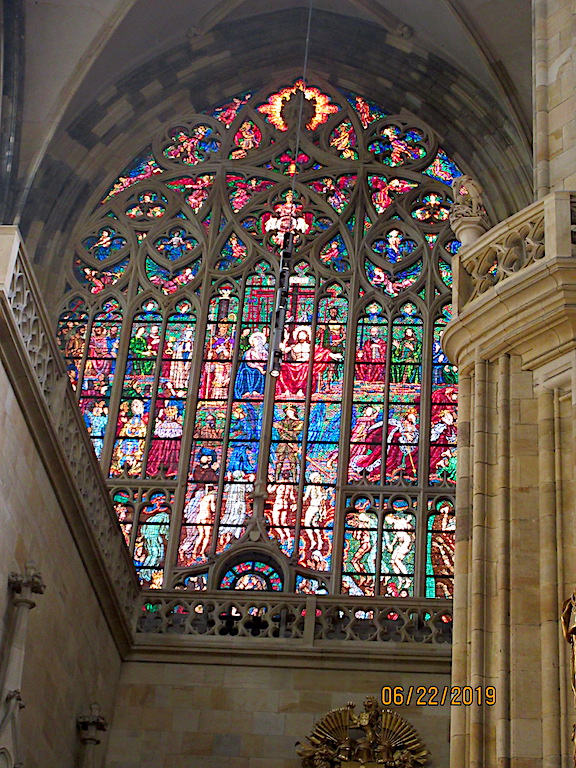
We visited several churches within the Castle grounds including one, originally begun in the year 870 as the Church of Virgin Mary. Over the years many kings, rulers and even the Habsburgs added and remodeled the property. Having such a long and sorted history, the castle has virtually every architectural style present. The castle today is enormous, occupying an area of almost 750,000 square feet or more than 17 acres. It is one of the most visited tourist attractions in Prague with over 1.8 million visitors annually.
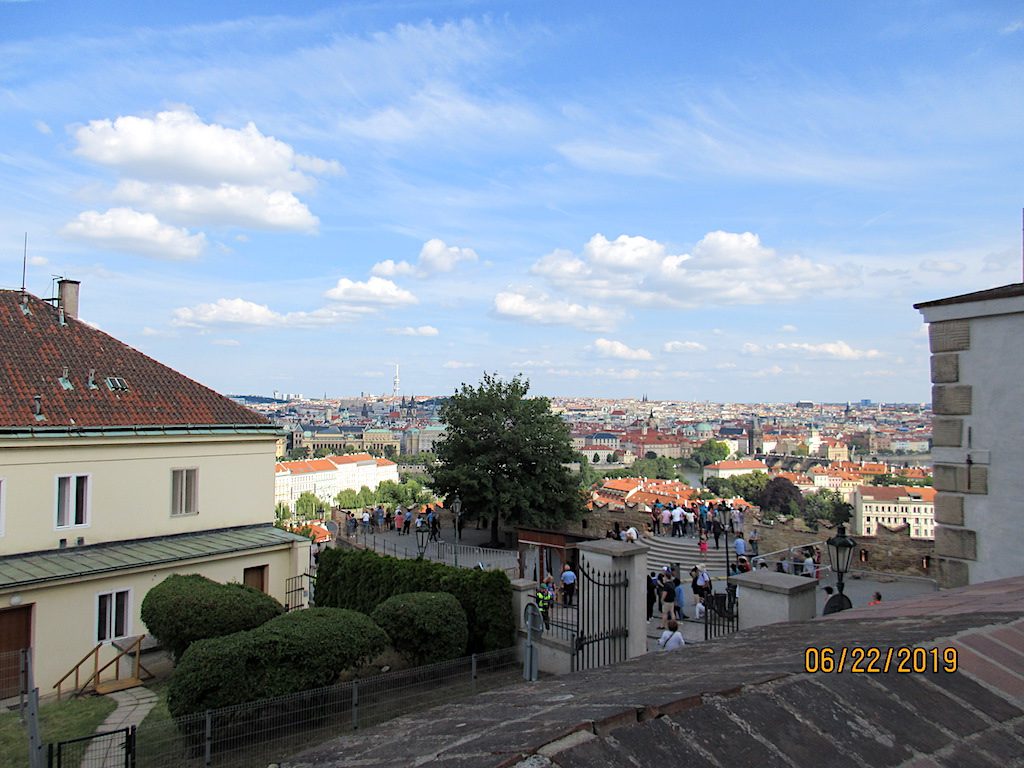
Inside the castle there are several museums, including the National Gallery, a Toy Museum, a museum of Czech History. The Summer Shakespeare Festival takes place here. In addition to the castle structure there are also many lovely gardens including the Royal Garden dating back to 1540. Unfortunately, we did not have time to take in all of the things to see.

For dinner we ate at the first Indian Restaurant in Prague and it has been around since 1978. The food was good but the service was poor. One waiter for about ten tables of people.